English
 Arabic
 French
 Spanish
 Portuguese
 Deutsch
 Turkish
 Dutch
 Italiano
 Russian
 Romaian
 Portuguese (Brazil)
 Greek
Protective Clothing Market Gains Momentum at 5.62% CAGR
Health |
2026-10-06 06:35:46
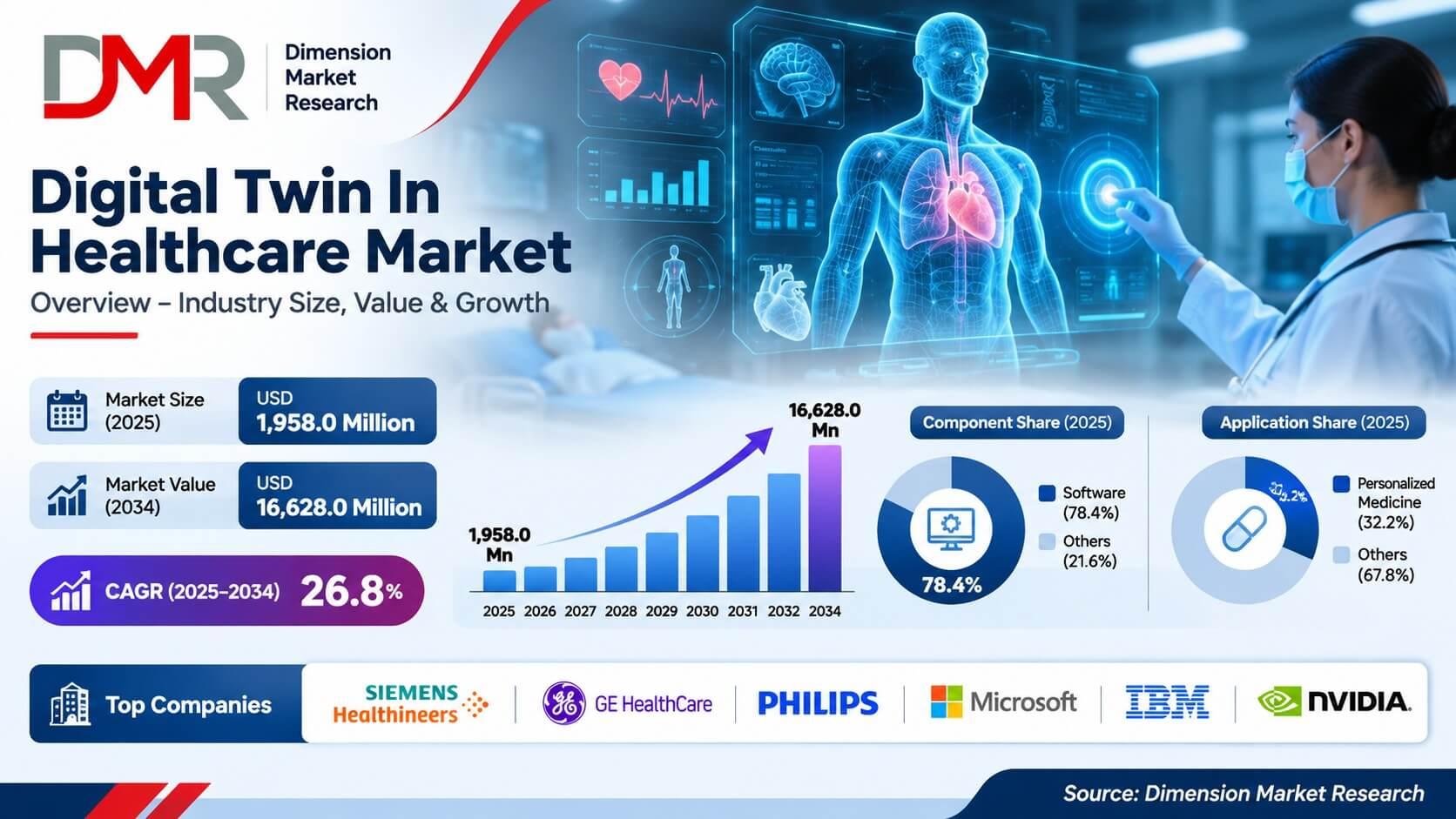
According to Dimension Market Research, the Digital Twin in Healthcare Market size is projected to reach USD 1,958.0 million in 2025 and grow to USD 16,628.0 million by 2034, registering a CAGR of 26.8% during 2025–2034. Increasing adoption of artificial intelligence, real-time patient monitoring, and personalized medicine is accelerating the integration of digital twin technology across healthcare systems.
Healthcare providers are increasingly exploring virtual patient models to improve treatment planning, predict medical complications, and enhance operational efficiency. These developments are creating new opportunities for technology providers, pharmaceutical companies, medical device manufacturers, and healthcare institutions.
The Digital Twin in Healthcare Market is gaining momentum as healthcare organizations adopt advanced technologies to improve clinical decision-making and patient outcomes. Digital twins create virtual representations of patients, organs, medical devices, and healthcare facilities using real-time information collected through IoT sensors, electronic health records, and connected medical equipment.
These virtual models allow healthcare professionals to simulate treatment responses, monitor patient conditions, and identify potential complications before they occur. Applications across precision medicine, surgical planning, drug development, and hospital management are expanding the technology's commercial potential.
Request Sample PDF of This Report: https://dimensionmarketresearch.com/request-sample/digital-twin-in-healthcare-market/
The market research highlights increasing demand for software-based digital twin solutions, particularly for predictive analytics, disease modeling, and precision medicine. Software is expected to dominate the component segment with a 78.4% revenue share in 2025. Personalized medicine is projected to lead applications with 32.2%, while healthcare providers are expected to account for 38.5% of end-user revenue. North America maintains a strong market position because of advanced healthcare infrastructure, technology investments, and established industry participants. Meanwhile, Europe is expected to record significant growth, supported by virtual human twin initiatives, healthcare digitization, and research collaborations.
The market is expanding because healthcare organizations increasingly require accurate, data-driven solutions for patient management and operational planning. The growing adoption of telemedicine, remote patient monitoring, AI-powered diagnostics, and connected medical devices is strengthening demand for digital twin platforms. These technologies help healthcare professionals analyze real-time patient information and develop personalized treatment strategies. Pharmaceutical companies are also exploring virtual patient simulations to improve drug discovery and clinical trial efficiency. Furthermore, increasing investments in healthcare digitization and predictive analytics are supporting broader technology adoption.
North America held a leading position in the Digital Twin in Healthcare Market, accounting for 48.2% of regional revenue in 2024. The region benefits from advanced healthcare infrastructure, strong technology investments, and the presence of companies such as Microsoft, IBM, and IQVIA. The United States is a major contributor, supported by innovation in AI, connected medical devices, and personalized healthcare solutions.
Europe is projected to register a high CAGR during the forecast period. Government-backed research initiatives, including the European Virtual Human Twins Initiative, and growing collaborations between healthcare institutions and technology companies are supporting regional adoption.
Software is expected to dominate the component segment, accounting for 78.4% of market revenue in 2025. Its growing importance comes from its ability to support real-time monitoring, advanced simulations, predictive analytics, and personalized treatment planning. Cloud-based platforms further improve accessibility, scalability, and integration with electronic health records and hospital information systems.
Read More About This Market: https://dimensionmarketresearch.com/report/digital-twin-in-healthcare-market/
Personalized medicine is projected to capture 32.2% of application revenue in 2025. Digital twins allow healthcare professionals to develop patient-specific virtual models using medical history, genetic information, and real-time health data. These simulations help evaluate potential treatment responses, improve therapy selection, and support more targeted disease management.
AI integration, machine learning, and real-time data analytics are among the major trends shaping the market. Healthcare organizations are increasingly using digital twins to simulate patient conditions, evaluate treatment outcomes, and improve clinical workflows. Another important trend is the adoption of virtual patient models in drug discovery and clinical trials. Pharmaceutical companies can use simulated patient responses to support research decisions and improve development efficiency. Additionally, hospitals are adopting facility-level digital twins to optimize equipment utilization, staff scheduling, and patient flow.
Predictive patient care represents a significant opportunity for digital twin technology providers. Combining wearable devices, IoT sensors, electronic health records, and AI analytics can enable more continuous health monitoring and earlier identification of potential complications. Hospital infrastructure optimization also offers substantial potential through improved resource allocation and predictive equipment maintenance. Furthermore, pharmaceutical and biotechnology companies can explore digital twin applications to simulate drug responses and support clinical research. Increasing collaborations between healthcare providers, research institutions, and technology companies are expected to create additional commercial opportunities.
Despite strong growth potential, data privacy, cybersecurity, and implementation costs remain important market challenges. Digital twin platforms require access to accurate and reliable patient information from multiple sources, making data governance essential. Integration with existing hospital information systems and electronic health records can also be complex. Additionally, healthcare organizations must invest in software, connected devices, computing infrastructure, and skilled professionals. Regulatory considerations surrounding patient data and clinical applications may further influence adoption. Addressing these challenges will be important for building trust and expanding commercial deployment.
The competitive landscape includes established healthcare technology companies, AI innovators, software providers, and emerging digital health businesses. Key participants identified in the market research include:
Companies are focusing on AI-driven healthcare platforms, virtual patient modeling, strategic collaborations, and product innovation to strengthen their market positions. Recent developments include Unlearn AI's USD 50 million Series C funding in February 2024 and Ontrak's introduction of Mental Health Digital Twin technology in May 2024.
Get 10% instant discount on report purchase
Dimension Market Research (DMR) is a global market intelligence and consulting firm delivering data-driven insights that help organizations make informed strategic decisions. With expertise across 12+ industries and global markets, DMR provides syndicated reports, custom research, competitive analysis, white space analysis, and business strategy consulting.
Our research solutions combine analytical rigor, industry expertise, and forward-looking intelligence to identify opportunities, reduce risks, and support sustainable growth. Trusted by clients across diverse sectors, DMR is committed to delivering accurate, actionable insights that enable businesses to navigate evolving market landscapes with confidence.
Contact Us
Phone USA: +17323699777
Phone India: +919310023843
E-mail: enquiry@dimensionmarketresearch.com
Address USA: 957 Route 33, Suite 12 #308, Hamilton Square, NJ-08690
Address India: D44, Sector 6, Noida 201301, India