English
 Arabic
 French
 Spanish
 Portuguese
 Deutsch
 Turkish
 Dutch
Dutch
 Italiano
 Russian
 Romaian
 Portuguese (Brazil)
 Greek
Greek

Private Tutor In UAE - Study Support That Actually Sticks
Literature |
2026-10-07 05:32:26
Assisted reproductive technology (ART) procedures require carefully controlled laboratory environments to support the handling of oocytes, sperm, and embryos. Laminar Airflow System Setup Services help fertility clinics establish suitable work zones by integrating appropriate airflow equipment, HEPA filtration, environmental controls, and installation testing. Depending on the procedure and laboratory design, these systems can help reduce airborne particulate contamination around sensitive work areas. From sperm preparation and conventional IVF to intracytoplasmic sperm injection (ICSI), embryo culture, biopsy, and cryopreservation, airflow solutions must be selected according to the specific workflow, equipment, and environmental requirements. A properly planned setup forms one part of a broader laboratory quality-management and contamination-control programme.
ART laboratories handle biological material that must be protected from avoidable environmental disturbances. Airborne particles, volatile organic compounds (VOCs), temperature fluctuations, and inappropriate handling conditions may affect the laboratory environment and require careful management.
A suitable airflow strategy can help clinics:
Reduce airborne particulate contamination in designated work areas.
Support aseptic handling practices.
Integrate HEPA filtration into laboratory environmental controls.
Maintain suitable airflow patterns around workstations.
Support temperature and humidity management.
Improve workflow when equipment and work areas are correctly positioned.
Establish measurable performance criteria for commissioning and maintenance.
The 2026 European Society of Human Reproduction and Embryology (ESHRE) recommendations emphasize controlled laboratory environments, HEPA filtration, VOC control, air-quality monitoring, and suitable handling conditions for reproductive cells and tissues. These recommendations reinforce that airflow is one component of a comprehensive laboratory-quality strategy, not a substitute for good laboratory practice. (ESHRE recommendations).
Sperm preparation is an important step in several ART treatment pathways. Depending on the treatment plan, laboratory staff may process semen samples using methods such as density-gradient centrifugation or swim-up techniques.
Airflow planning for sperm preparation areas should consider:
Suitable workbench and equipment placement.
Cleanable work surfaces.
Appropriate ventilation and air filtration.
Separation from activities that may release chemicals or particles.
Access to temperature-controlled equipment where required.
Efficient movement of specimens and laboratory personnel.
A well-designed workspace helps staff carry out preparation procedures consistently while minimizing unnecessary movement and exposure of specimens to uncontrolled conditions.
Airflow equipment should be selected according to the task being performed. A clean bench designed to protect a product from airborne particles is not automatically suitable for every biological or chemical hazard. The clinic should assess the risks associated with each procedure and select the appropriate containment or protective equipment.
Conventional IVF involves combining prepared sperm with retrieved oocytes under controlled laboratory conditions. The laboratory environment must support careful specimen handling, stable culture conditions, and appropriate identification and traceability.
Airflow system planning for conventional IVF should consider:
A suitable location for insemination workstations.
Appropriate HEPA-filtered airflow where specified.
Temperature-controlled work surfaces or heating stages.
Control of potential VOC sources.
Efficient specimen movement between preparation and culture areas.
Environmental monitoring and documented operating procedures.
The objective is to create an environment in which laboratory staff can perform procedures with consistent handling practices and minimal unnecessary exposure of reproductive cells to uncontrolled conditions.
Airflow alone cannot guarantee fertilization or pregnancy outcomes. Media quality, equipment performance, staff expertise, specimen handling, and other clinical factors remain important.
ICSI involves injecting a selected sperm cell directly into an oocyte using specialized micromanipulation equipment. The procedure requires precision, suitable ergonomics, and stable operating conditions.
Airflow setup for ICSI workstations should consider:
Placement of microscopes and micromanipulation systems.
Suitable airflow around the working area.
Vibration control and stable work surfaces.
Integration of heated stages and associated equipment.
Access to electrical and gas supplies where required.
Maintenance access without disturbing the workstation layout.
The airflow arrangement should not create disruptive turbulence around delicate procedures or interfere with equipment operation. Engineers and embryologists should work together to determine the best workstation position and the relevant performance criteria.
A customized setup can help the laboratory coordinate environmental controls and equipment layout while preserving efficient movement and specimen traceability.
Following fertilization, embryos are cultured under carefully controlled conditions. Temperature, pH, gas composition, and handling time are important considerations, so laboratory design must account for more than room cleanliness alone.
Airflow setup should support embryo culture by considering:
The placement and number of incubators.
Appropriate room temperature and humidity control.
HEPA filtration and VOC management where specified.
Airflow distribution around equipment.
Electrical and backup-power arrangements for critical systems.
Environmental monitoring and alarm integration.
Maintenance access for incubators and ventilation components.
Incubators should be selected and positioned according to laboratory workload and the manufacturer's requirements. The room ventilation system should be assessed for heat loads from incubators and other equipment.
ESHRE's 2026 recommendations highlight the importance of controlled laboratory air quality, suitable environmental conditions, qualified equipment, and documented maintenance. These measures work together to support consistent laboratory operations.
Some fertility clinics perform embryo biopsy for preimplantation genetic testing (PGT). This procedure involves specialized handling of embryo material and requires carefully controlled working practices.
Airflow planning should consider:
The location of biopsy workstations.
Microscope and micromanipulation equipment requirements.
Suitable particulate control.
Environmental conditions for specimen handling.
Separation of incompatible activities.
Cleaning and maintenance access.
Procedures for specimen identification and traceability.
Where additional molecular testing is performed, the laboratory should assess whether sample preparation and analytical activities require separate work areas to reduce the risk of cross-contamination.
Airflow systems must be selected according to the actual risks and tasks involved. A conventional laminar-flow clean bench protects the work product from airborne contamination but does not necessarily protect the operator from hazardous aerosols or biological agents. Where personnel protection or containment is required, an appropriate biological safety cabinet or other engineered control should be selected following a risk assessment. (CDC laboratory safety guidance).
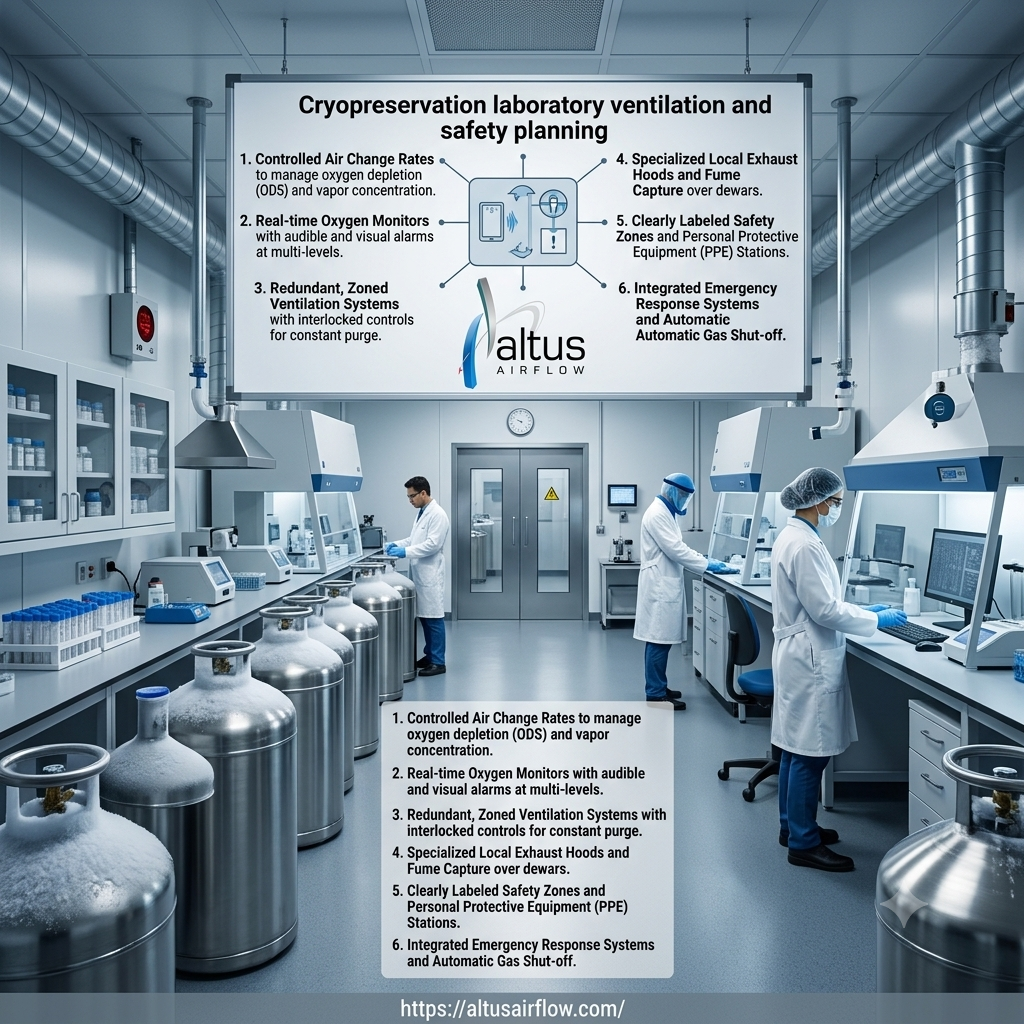
Cryopreservation involves freezing reproductive material for future use. Although the storage process has different environmental requirements from open laboratory manipulation, the associated rooms and equipment still need careful planning.
Airflow and facility planning should consider:
Suitable positioning of cryostorage equipment.
Access for authorized personnel.
Appropriate ventilation and safety measures.
Monitoring and alarm arrangements.
Backup power for relevant monitoring systems.
Clear access routes for equipment servicing.
Separation of storage functions from the main working area where appropriate.
Liquid nitrogen storage presents specific occupational and oxygen-displacement risks. Ventilation and oxygen monitoring should be designed according to the storage quantity, room configuration, applicable safety requirements, and documented risk assessment.
ESHRE recommends that cryopreservation storage facilities incorporate appropriate precautions and be located separately from the main laboratory working area while remaining conveniently accessible. A laminar airflow workbench should not be assumed to be necessary for every cryostorage task; equipment selection must reflect the activity being performed.
HEPA filtration is an important component of particulate control. It captures particles in the air passing through the filter, helping reduce airborne particulate levels when the system is properly designed and maintained.
However, HEPA filters do not remove all gaseous pollutants. VOCs and other gaseous contaminants may require source control, suitable ventilation, and compatible gas-phase filtration, such as appropriately selected activated-carbon media.
Professional setup planning should consider:
Filter efficiency and intended application.
Correct filter housing and sealing.
Airflow rate and distribution.
Filter-integrity testing where required.
VOC sources from construction materials and consumables.
Gas-phase filtration where justified.
Scheduled filter inspection and replacement.
Environmental monitoring and recordkeeping.
ESHRE's 2026 recommendations identify both HEPA filtration and VOC control as relevant to IVF laboratory air quality. Low-emission construction materials, appropriate off-gassing periods after renovation, and regular environmental assessment are also important.
A laminar airflow installation should be coordinated with the laboratory's overall HVAC strategy. The complete system must provide suitable environmental conditions without creating unwanted pressure relationships, temperature fluctuations, or disruptive airflow patterns.
Important design considerations include:
Room temperature and relative humidity.
Supply and return-air arrangements.
Required fresh-air provision.
Room pressure relationships.
Airflow distribution and velocity.
Heat generated by laboratory equipment.
Environmental sensors and alarm systems.
Access for testing and preventive maintenance.
Monitoring systems may record temperature, humidity, pressure differentials, and other specified parameters. Particle counting and VOC assessment may also be included when required by the laboratory's quality programme.
The clinic should establish acceptable operating ranges and a documented response process for readings outside those limits. Measurements should be taken using suitable, calibrated instruments and reviewed by qualified personnel.
Successful airflow performance depends on correct equipment selection, installation, balancing, and verification. A system should not be considered ready for use simply because the fan is operating.
Commissioning activities may include:
Reviewing the laboratory's requirements and proposed layout.
Confirming equipment specifications and installation locations.
Checking filter installation and housing integrity.
Measuring airflow velocity and distribution where applicable.
Verifying pressure relationships where specified.
Checking temperature and humidity controls.
Testing alarms and control functions.
Recording results and correcting deficiencies.
Providing maintenance documentation and staff guidance.
The exact tests and acceptance criteria should follow the equipment design, applicable standards, and the clinic's approved specifications. Reassessment may be necessary after major changes to equipment, layout, filtration, or ventilation.
Airflow performance can deteriorate if filters become loaded, seals are damaged, or ventilation components are not serviced correctly. A preventive-maintenance programme helps the clinic detect problems and maintain the system within its approved operating conditions.
Maintenance should include:
Regular inspection of fans and ventilation components.
Filter pressure-drop monitoring.
Filter-integrity testing where required.
Cleaning of accessible surfaces and grilles.
Sensor calibration and alarm checks.
Periodic airflow verification.
Documentation of repairs and replacements.
Recommissioning after significant modifications where required.
The clinic should retain maintenance records and assign clear responsibility for monitoring results, responding to alarms, and authorizing return to service after repairs.
Different ART procedures have distinct workflow, equipment, environmental, and safety requirements. Laminar Airflow System Setup Services support fertility laboratories by helping plan appropriate workstations, HEPA filtration, airflow distribution, HVAC integration, environmental monitoring, and performance testing. The correct solution depends on whether the laboratory is performing sperm preparation, conventional IVF, ICSI, embryo culture, biopsy, or cryopreservation. Airflow must be integrated with VOC control, suitable equipment, aseptic techniques, quality management, and risk-based maintenance. For fertility clinics planning specialized airflow and controlled laboratory environments, Altus Airflow can support infrastructure planning, system installation, and performance verification tailored to the facility's requirements.
They help establish controlled work areas, suitable filtration, and appropriate airflow arrangements for tasks involving reproductive cells. Laminar Airflow System Setup Services should be planned around the clinic's procedures, equipment, and environmental requirements.
They may support particulate control around appropriately designed ICSI workstations. Laminar Airflow System Setup Services should also consider microscope positioning, vibration, temperature control, and the effects of airflow on equipment operation.
HEPA filtration is recommended as part of IVF laboratory air-quality management in current ESHRE guidance. Laminar Airflow System Setup Services should integrate suitable filtration with VOC control, HVAC design, monitoring, and documented maintenance.
HEPA filters capture airborne particles but do not effectively remove most gaseous VOCs. Laminar Airflow System Setup Services should therefore consider source control, ventilation, and appropriate gas-phase filtration where required.
Not every cryopreservation activity requires a laminar airflow workbench. Laminar Airflow System Setup Services should be selected according to the task, equipment, contamination-control needs, and safety requirements of the storage area.
Read Our Previous Blog------>How can fertility clinics plan for future expansion through IVF Labs Design?