English
 Arabic
 French
 Spanish
 Portuguese
 Deutsch
 Turkish
 Dutch
 Italiano
 Russian
 Romaian
 Portuguese (Brazil)
 Greek

Sponsorship Rate Card and Negotiation Guide for Creators in 2026
Creator Monetization & Revenue |
2026-10-03 05:09:58
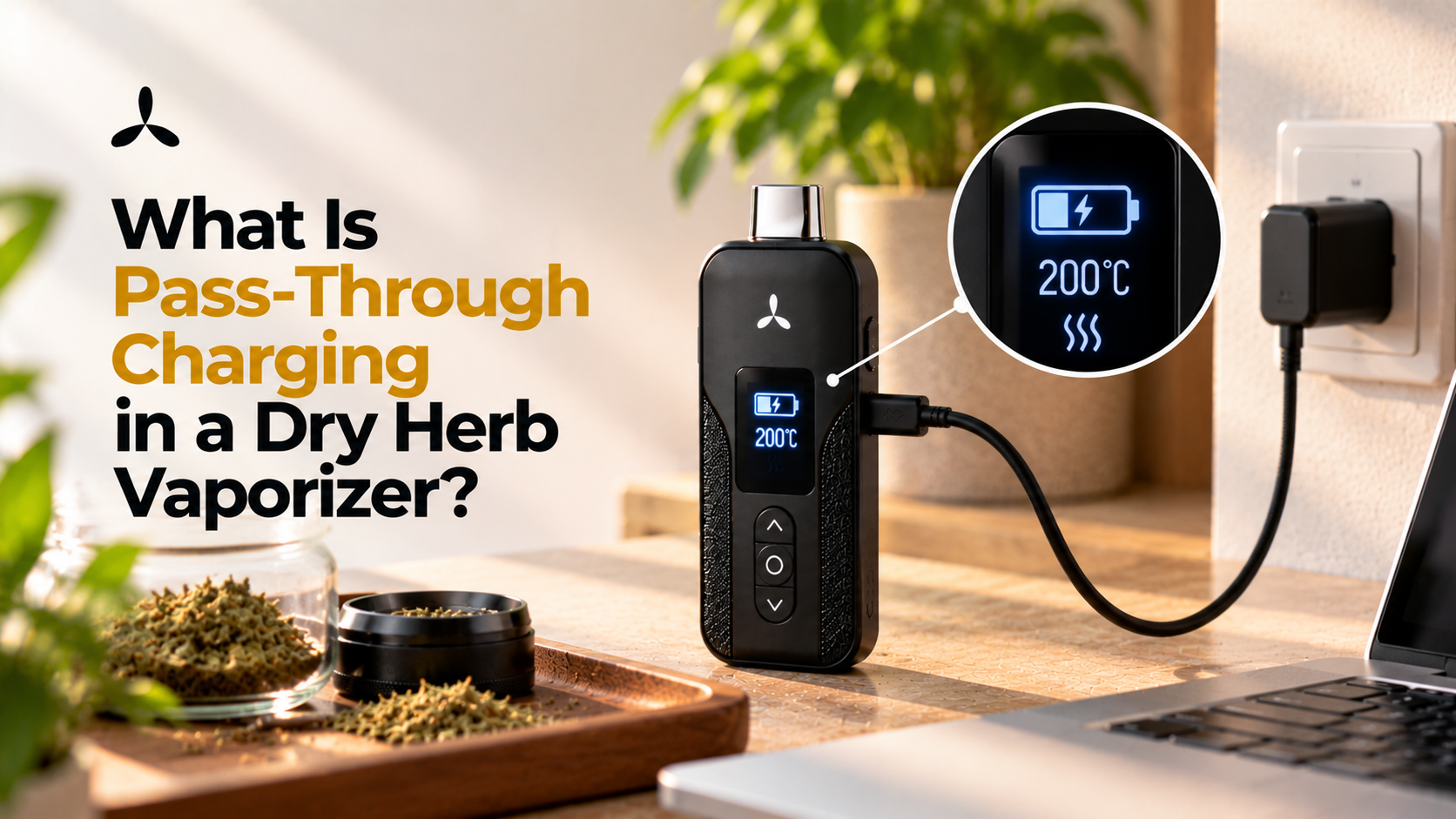
Portable dry herb vaporizers depend on rechargeable batteries, which makes charging an important part of everyday use. But what happens when your battery is running low and you want to use your vaporizer before charging is complete?
This is where pass-through charging can become useful.
Pass-through charging allows certain vaporizers to operate while they are connected to a power source. Instead of waiting for the battery to reach a full charge, a compatible device may continue functioning while plugged in.
However, pass-through charging is not available on every vaporizer, and the exact way it works varies between models. It is also important to distinguish between a device that can simply remain powered on while charging and one that can actually activate its heating system during charging.
This guide explains what pass-through charging is, how it works, its advantages and limitations, and what to check before using a dry herb vaporizer while it is plugged in.
Pass-through charging is a feature that allows an electronic device to be used while its rechargeable battery is connected to an external power source.
In a dry herb vaporizer, this generally means the vaporizer can continue operating while connected to a compatible charger.
For example, imagine your vaporizer has only a small amount of battery power remaining. With a device that supports pass-through operation, you may be able to connect the charging cable and continue using the vaporizer without waiting for a complete recharge.
The exact implementation depends on the device.
Some vaporizers allow full operation while connected to power. Others may permit charging and basic electronic functions but disable the heater until sufficient battery power is available.
That distinction matters because a vaporizer's heater requires substantially more power than simple electronics such as its display or control buttons.
A rechargeable vaporizer contains several components involved in power management, including:
Rechargeable battery
Charging circuit
Power-management electronics
Heating element
Temperature-control system
USB or USB-C charging connection
When a standard vaporizer is plugged in, incoming electricity is primarily used to recharge the battery.
A vaporizer designed for pass-through operation has a power-management system that can manage charging while allowing the device to operate at the same time.
The process can be simplified like this:
Power source → charging and power-management circuitry → battery and device electronics
When the heater is activated, the vaporizer requires considerably more energy than it does while simply displaying information or remaining switched on.
Because of that power demand, many portable vaporizers still rely partly or primarily on their internal battery during pass-through operation.
In other words, plugging a vaporizer into USB does not necessarily mean the USB connection alone is directly powering the heater.
These terms are often treated as interchangeable, but they are not always identical.
A manufacturer's specifications might state that a device supports charging while powered on, yet that does not automatically mean the heating chamber can operate during charging.
There are roughly three possible configurations.
The vaporizer cannot be used while connected to power.
You plug it in, allow the battery to recharge, disconnect it, and then use the device.
The device may switch on or display battery information while plugged in, but the heating system remains disabled.
The vaporizer can heat and run a session while connected to the charger, assuming other requirements, such as having some remaining battery charge, are met.
This is why checking the manufacturer's instructions is more reliable than assuming every USB-C vaporizer supports pass-through use.
USB-C describes the connection standard, not necessarily the device's pass-through capabilities.
Not necessarily.
This is one of the most misunderstood aspects of pass-through charging.
Some vaporizers that support pass-through use still require the internal battery to contain a minimum amount of charge before the heating system will operate.
The reason comes back to power requirements.
Heating a vaporizer chamber to operating temperature requires a substantial burst of energy. A normal USB charging connection may not always provide enough instantaneous power to run the heater independently.
The battery may therefore act as part of the power supply even while the charging cable is connected.
For example, AirVape currently lists pass-through operation for both the AirVape X and AirVape XS GO, while specifying that the battery should not be completely depleted.
If a battery has reached zero, you may therefore need to charge it for a while before attempting to start a session.
Pass-through charging is mainly a convenience feature.
It does not necessarily improve vapor quality or heating performance, but it can make a portable vaporizer easier to use when battery power is running low.
Without pass-through functionality, a depleted vaporizer may need to remain connected to a charger before it can be used again.
A compatible pass-through device can reduce that interruption.
Pass-through operation can be especially convenient when you are near a wall outlet, computer, or suitable USB power source.
You can connect the device while using it rather than relying entirely on the battery's remaining charge.
Rechargeable batteries gradually lose capacity through normal ageing and charge cycles.
As battery runtime decreases, pass-through functionality can become useful because the device can remain connected during operation when supported.
That does not mean pass-through charging repairs an ageing battery. A noticeably degraded battery should still be inspected or replaced according to the manufacturer's recommendations.
No.
Pass-through charging and fast charging are separate features.
Pass-through charging refers to whether the device can operate while connected to power.
Fast charging refers to how quickly the battery can accept electrical energy.
A vaporizer may support:
Pass-through charging but not fast charging
Fast charging but not pass-through operation
Both features
Neither feature
The charging connector also does not answer the question by itself.
USB-C, for example, can support many different power configurations, but whether a particular vaporizer uses those capabilities depends on its internal electronics.
USB-C has become increasingly common in portable electronics because the connector is reversible, compact, and capable of supporting different power levels.
For vaporizers, USB-C can offer practical benefits such as easier cable compatibility and, on appropriately designed devices, faster charging.
However:
USB-C does not automatically mean pass-through charging.
Manufacturers determine whether a device permits heating during charging through its battery-management hardware, firmware, thermal controls, and overall electrical design.
When comparing dry herb vaporizers, look specifically for terminology such as:
Pass-through charging
Use while charging
Pass-through operation
Operates while plugged in
Do not infer the feature simply because a vaporizer has a USB-C port.
A vaporizer designed by its manufacturer for pass-through operation should include electrical and thermal management appropriate for that function.
However, charging and heating both produce heat, meaning using the two functions simultaneously can increase thermal load inside the device.
For that reason, users should follow the manufacturer's instructions rather than attempting to force pass-through operation on unsupported hardware.
Basic charging practices include:
Use the recommended charging cable and compatible power source.
Avoid damaged cables or loose charging connectors.
Do not cover the vaporizer while it is charging.
Keep the charging port dry and clean.
Avoid using a device that becomes unusually hot.
Do not attempt to modify battery or charging circuitry.
Follow the manufacturer's charging instructions.
Portable vaporizers contain lithium-based rechargeable batteries, and proper charging practices matter for both reliability and battery longevity.
Potentially, although the effect depends heavily on device design and usage habits.
Rechargeable batteries naturally degrade over time. Battery ageing is influenced by factors such as:
Temperature
Charge cycles
Time spent at very high or very low charge levels
Discharge depth
Charging behaviour
Heat is particularly relevant.
Running the heater while simultaneously charging may produce more internal heat than performing either task separately. A well-designed vaporizer manages this through its electronics and thermal design, but frequent exposure to excessive temperatures is generally undesirable for rechargeable batteries.
That does not mean occasional pass-through use will suddenly damage a compatible vaporizer.
It simply means pass-through charging is best viewed as a convenience feature rather than something you necessarily need to use during every session.
There is another way manufacturers address charging downtime: replaceable batteries.
With a removable-battery vaporizer, a depleted battery can sometimes be exchanged for a charged compatible battery instead of waiting for the device itself to recharge.
These two approaches solve similar problems differently.
|
Feature |
Pass-Through Charging |
Replaceable Battery |
|
Continue after battery runs low |
Often |
Yes, with charged spare |
|
Requires cable during operation |
Yes |
No |
|
Battery can be swapped |
Usually no requirement |
Yes |
|
Convenient near power source |
Very |
Less important |
|
Convenient away from power source |
Limited |
Strong with spare batteries |
Neither system is automatically better.
A user who mainly uses a vaporizer at home may appreciate pass-through functionality, while someone spending long periods away from charging points may prefer replaceable batteries.
Some premium devices combine multiple approaches.
Only if the manufacturer explicitly supports it.
Trying to operate an unsupported vaporizer while connected to a charger is unnecessary and may interfere with proper charging or device protection systems.
Before using pass-through operation:
Check the manufacturer's specifications.
Confirm that heating while charging is supported.
Make sure the battery has the required minimum charge.
Use an appropriate charging cable and power source.
Stop using the device if it becomes abnormally hot.
If the manual tells you to wait until charging is finished, that instruction should take priority.
Device engineers have already done the tedious electrical calculations, mercifully saving everyone else from conducting battery experiments on the coffee table.
Pass-through capability varies across vaporizer models, so individual product specifications should always be checked.
For example, AirVape EU currently lists the AirVape X as supporting pass-through use while charging when its 1300 mAh battery is not completely depleted. The device uses Micro USB charging and has an approximate one-hour charge time.
The AirVape XS GO similarly lists pass-through use while charging when its battery still contains some charge. It uses a 1200 mAh rechargeable battery and has an approximate charging time of 45 minutes.
Other AirVape models may use different battery and charging systems. For example, the Legacy CORE uses USB-C charging, illustrating why the charging connector and pass-through capability should be considered as separate specifications.
When comparing devices, always check the current product specification rather than assuming the same charging behaviour applies across an entire vaporizer range.
Pass-through functionality is useful, but it should not be the only battery feature considered when choosing a dry herb vaporizer.
Look at the complete charging system.
Battery capacity is usually expressed in milliamp-hours, or mAh.
Higher capacity can contribute to longer operating time, although actual runtime also depends on heater power, temperature, session duration, electronics, and overall efficiency.
A larger battery is useful, but a very long recharge time can reduce convenience.
Consider the relationship between runtime and charging speed.
USB-C is increasingly convenient because one cable may work across multiple modern devices.
Older models may use Micro USB.
Replaceable batteries can extend usability away from charging points, while built-in designs can allow manufacturers to create smaller or more integrated devices.
A clear battery indicator reduces the likelihood of unexpectedly running out of power.
Some vaporizers use LEDs, while others provide a more detailed battery display.
If uninterrupted use is important to you, verify this feature directly in the manufacturer's specifications.
False.
USB-C is a connector and power-delivery standard. Pass-through operation depends on the vaporizer's internal design.
Not always.
Many devices still depend on their internal battery to provide some or most of the heater's immediate power requirements.
Not necessarily.
Some pass-through devices require a minimum battery charge before heating is permitted.
No.
These are separate specifications.
Not really.
Its main advantage is convenience. If your battery already provides enough runtime for your routine, you may rarely need it.
For many users, yes, especially as a backup feature.
You may not use pass-through charging every day, but it becomes useful when you discover the battery is nearly empty immediately before a session.
It can be particularly valuable for users who:
Frequently use their vaporizer at home
Forget to charge between sessions
Prefer fewer interruptions
Use their device frequently throughout the day
Want an additional layer of charging flexibility
Users who spend more time away from electrical outlets may care more about overall battery capacity, power-bank compatibility, or replaceable batteries.
The best choice depends on how and where the device will actually be used.
Pass-through charging in a dry herb vaporizer allows a compatible device to operate while connected to an external power source.
Its biggest advantage is convenience. Instead of always waiting for a battery to recharge completely, a supported vaporizer may allow you to continue a session while the charging cable is connected.
However, implementation varies significantly between devices.
Some vaporizers support complete heating operation while charging. Others require a minimum battery level, while some disable the heater entirely whenever a charging cable is connected.
When comparing vaporizers, check the manufacturer's specifications for pass-through use specifically, rather than assuming USB-C, fast charging, or a large battery automatically provides the feature.
Ultimately, pass-through charging is one small part of a good portable vaporizer design. Battery capacity, recharge time, heating efficiency, charging connection, replaceable-battery options, temperature control, and overall usability are equally important when deciding which device fits your routine.
Pass-through charging generally means a vaporizer can continue operating while connected to a charging source. The exact functionality varies by model, so check whether the manufacturer specifically allows heater operation during charging.
No. Only use a vaporizer while charging if the manufacturer states that the device supports this function.
Not always. Some vaporizers require a minimum amount of battery charge because the internal battery helps supply the power required by the heater.
No. USB-C identifies the connection type. Whether a vaporizer supports pass-through operation depends on its internal power-management system.
No. Pass-through charging describes using a device while it is plugged in. Fast charging describes how quickly the battery can recharge.