English
 Arabic
 French
 Spanish
 Portuguese
 Deutsch
 Turkish
 Dutch
Dutch
 Italiano
 Russian
 Romaian
 Portuguese (Brazil)
 Greek
Greek

Total Wash and Stripe: Commercial Dumpster Pad Cleaning for Cleaner Business Environments
Other |
2026-09-28 15:09:43
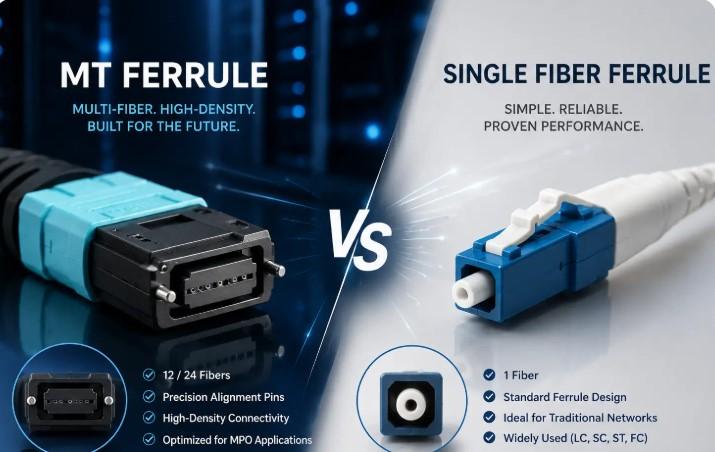
Modern optical networks depend on precision components to maintain reliable communication between connected systems. As data centers, telecommunications facilities, cloud infrastructure, and high-performance computing environments continue to expand, the demand for compact and dependable fiber connectivity is increasing. While cables carry optical signals across a network, the components at connection points are equally important. FSG Network provides fiber optic connectivity products designed for applications where accurate fiber alignment, high connection density, and consistent performance are essential.
An MT ferrule is a precision component used to hold and align multiple optical fibers within a fiber optic connector. The term MT refers to Mechanical Transfer, and the ferrule uses precisely formed holes to position the fibers in a controlled arrangement.
Unlike a conventional single-fiber ferrule, an MT ferrule can accommodate several fibers in one component. This makes it particularly useful for multi-fiber connectivity systems where many optical channels need to be handled within a compact space.
When incorporated into an MT ferrule connector assembly, the ferrule helps maintain accurate alignment between corresponding fibers. This alignment is important because even small positioning differences can influence optical performance.
Optical signals travel through the core of a fiber, which is extremely small. For two fibers to communicate efficiently through a connector, their cores must be positioned accurately relative to each other.
The MT ferrule provides a structured platform for maintaining this alignment. Its precision holes, guide-pin arrangement, and polished end face work together to support repeatable connections.
A properly manufactured MT ferrule connector can therefore contribute to consistent optical performance across a multi-fiber network. This becomes increasingly important when a facility contains hundreds or thousands of optical connections.
For network designers, choosing precision-manufactured components can help create infrastructure that is easier to deploy, test, maintain, and expand.
MT ferrules are commonly associated with multi-fiber connectors such as MPO systems. Instead of connecting each fiber separately, multiple fibers can be arranged within a single ferrule and connected through one compact interface.
This design is useful for high-density applications because it can reduce the physical space required for multiple optical connections. Data centers, telecommunications facilities, and enterprise networks can use multi-fiber systems to organize large numbers of optical paths.
FSG Network specializes in MT ferrule products and related MPO connectivity components. Its product portfolio includes ferrules designed for different fiber counts and applications, allowing customers to select configurations according to their network requirements.
Data centers require efficient cabling because large quantities of information move between servers, switches, storage systems, and other network equipment. As equipment density increases, traditional approaches to individual fiber connections can create additional cable management challenges.
An MT ferrule connector can support multi-fiber connectivity by allowing several optical fibers to be aligned and connected through a single interface. This can help reduce connection complexity and support more organized infrastructure.
When combined with MPO trunk cables and breakout assemblies, MT-based connectivity can form part of a structured cabling system. Backbone connections can use multi-fiber assemblies, while breakout connections can provide individual fiber interfaces where required.
Physical space is an important consideration when designing modern optical networks. Equipment racks, patching areas, and cable pathways may have limited capacity, particularly in large data centers.
Multi-fiber connectivity helps address this challenge by grouping several optical channels together. An MT ferrule connector is an important part of this approach because it provides the precision alignment needed for multiple fibers within a compact interface.
High-density infrastructure can also simplify future network expansion when it is designed with appropriate capacity from the beginning. Network planners can consider fiber counts, connector types, cable routing, and available rack space before installation.
The number of fibers supported by an MT ferrule is one of the important specifications to evaluate before selecting a component. Different network applications require different configurations, so the ferrule must match the intended connector and cable assembly.
Common multi-fiber configurations can include 8, 12, 16, 24, and higher fiber counts depending on the application and product design. FSG Network provides MT ferrule solutions in multiple configurations and also supports customized requirements.
Choosing the correct fiber count can help prevent unnecessary conversion components and make the final cabling architecture easier to manage. It is therefore important to review the requirements of connected equipment before ordering ferrules or complete assemblies.
MPO connectivity is widely used in high-density fiber environments because it allows multiple optical fibers to be connected through one interface. The MT ferrule forms a key mechanical element of many of these multi-fiber systems.
An MT ferrule connector needs to be compatible with the corresponding connector body, guide pins, fiber arrangement, and cable assembly. Proper compatibility ensures that the fibers align correctly when the connector is mated.
For this reason, network designers should consider the complete connector system rather than selecting a ferrule independently. Specifications for fiber count, dimensions, polarity, fiber type, and connector configuration should all be reviewed.
Precision manufacturing is essential when producing components designed to align multiple optical fibers. The positioning of the fiber holes must remain within appropriate tolerances so that the fibers can be aligned consistently.
The end face of the ferrule also needs to be properly processed because surface quality can influence the quality of the optical connection. Manufacturing controls and inspection procedures can help maintain consistency between individual components.
FSG Network focuses on MT ferrules as part of its fiber optic product range. Its portfolio includes standard and customized ferrule configurations intended for different multi-fiber applications.
For organizations purchasing components in volume, consistent manufacturing can be especially important because a network may contain a large number of identical connection points.
The ferrule end face is an important part of the optical connection. Before two connector assemblies are joined, their mating surfaces need to be clean and properly prepared.
Contamination such as dust or debris can interfere with optical transmission and may cause unnecessary signal loss. Regular inspection and appropriate cleaning procedures should therefore be part of fiber network maintenance.
During manufacturing, controlled polishing processes help create suitable end-face characteristics. After installation, technicians should follow appropriate inspection and cleaning practices to preserve connector performance.
These simple maintenance measures can help protect the reliability of an MT ferrule connector system over the operational life of a network.
High-performance computing and artificial intelligence systems can generate significant communication requirements between processing units, storage platforms, and switches. These environments often require high-density connections because substantial computing capacity may be installed within limited physical areas.
Multi-fiber optical connectivity can help accommodate these requirements. An MT ferrule connector provides the precision alignment needed to bring multiple optical fibers together within compact connector assemblies.
For infrastructure planners, the goal is not simply to increase the number of connections. The cabling system should also remain organized, accessible, and capable of supporting future equipment upgrades.
Before selecting an MT ferrule, buyers should review several technical factors. These include fiber count, fiber type, connector design, guide-pin requirements, dimensions, polishing specifications, and compatibility with the intended cable assembly.
The operating environment should also be considered. Temperature conditions, installation requirements, and expected service conditions can influence the appropriate component specification.
For customized projects, working with a manufacturer that can provide different configurations may be useful. Custom ferrule designs can help address specialized requirements that cannot be met through a standard configuration.
A modern fiber network should be designed with both current and future requirements in mind. Organizations may increase server capacity, deploy new cloud applications, expand data storage, or introduce higher-performance computing systems over time.
Using multi-fiber connectivity can provide a structured approach for handling these changes. When ferrules, connectors, cables, adapters, and breakout assemblies are selected as part of one coordinated architecture, future modifications can be easier to manage.
FSG Network offers a range of MT and MPO products that can be incorporated into different optical connectivity systems. This range allows network designers to consider standard or customized configurations based on project requirements.
Precision is fundamental to reliable fiber optic connectivity. When several optical fibers must be aligned within one compact connection, the quality and design of the ferrule become especially important. An MT ferrule connector provides the mechanical foundation needed to position multiple fibers accurately and support dependable multi-fiber communication.
FSG Network offers MT ferrule products and related fiber connectivity components for applications including data centers, telecommunications, enterprise networks, and advanced computing infrastructure. By considering fiber count, connector compatibility, polishing requirements, fiber type, and future network capacity, organizations can select components that fit their specific architecture.
A carefully designed MT-based connectivity system can contribute to organized, scalable, and maintainable optical infrastructure, helping modern networks manage growing connectivity requirements while making efficient use of available physical space.