English
 Arabic
 French
 Spanish
 Portuguese
 Deutsch
 Turkish
 Dutch
 Italiano
 Russian
 Romaian
 Portuguese (Brazil)
 Greek

How to Measure Guest Blogging ROI With Formulas That Work
Business & Entrepreneurship Insights |
2026-10-01 04:49:08
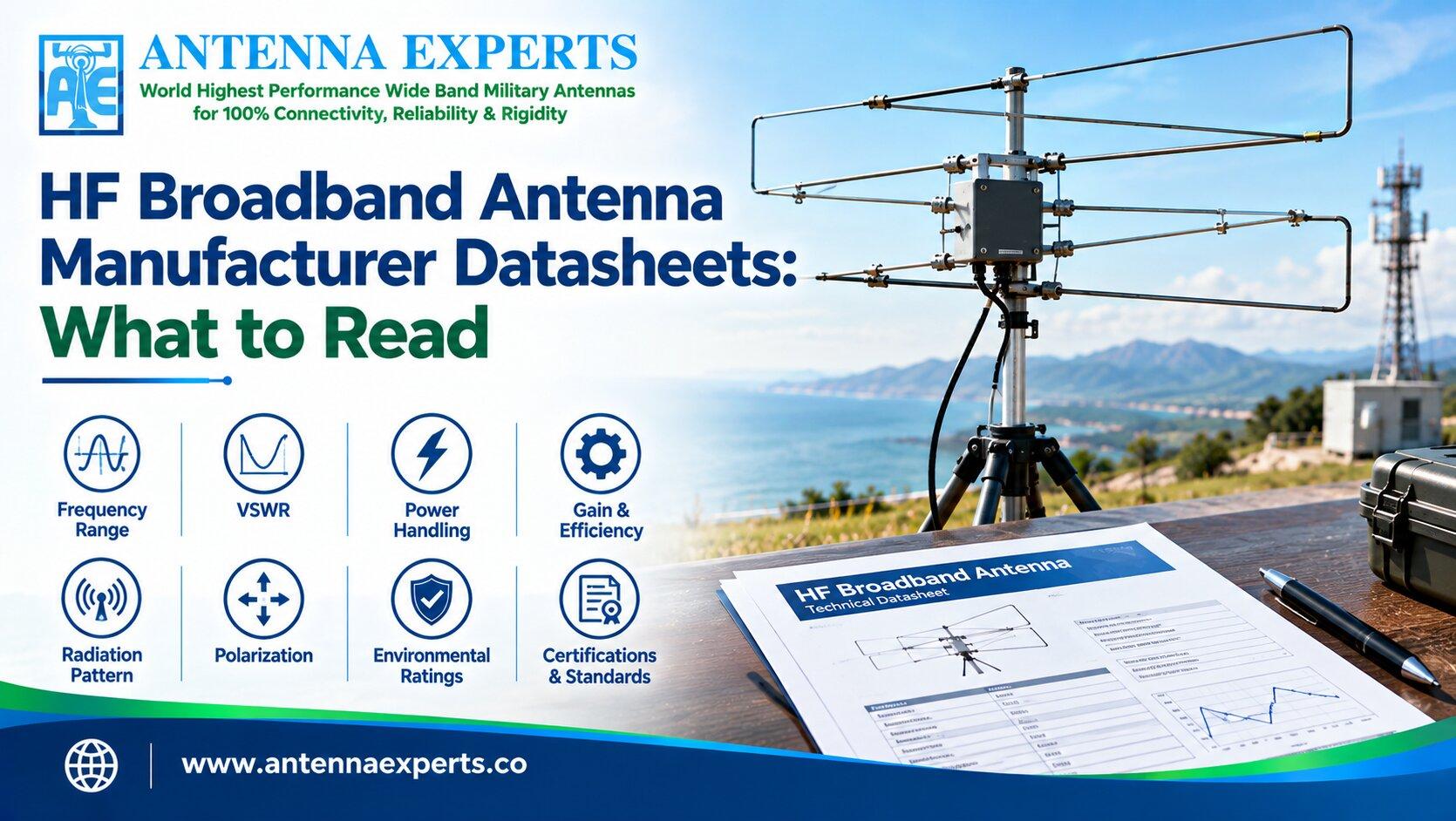
An HF broadband antenna datasheet will specify the frequency range, VSWR, power handling, radiation pattern and installation requirements. Each HF broadband antenna manufacturer formats it a little differently. The core numbers are identical. The product name gives you no indication of how the antenna performs over its band. The datasheet does. What does each part do? This guide explains. A good HF broadband antenna builder publishes these with every model.
What to Look for in an HF Broadband Antenna Datasheet
How to Read a VSWR Plot Across 2–30 MHz
VSWR is a measure of how much of the power the antenna reflects back instead of accepting. The 1:1 ratio is a perfect match. More power reflected means higher values.
A VSWR plot shows how that match changes as you move in frequency. Frequency is the horizontal axis. The vertical axis is the value of VSWR. The VSWR plot over 2-30 MHz should be read in its entire length. Look for peaks near the edges of the bands.
One VSWR number is not sufficient for a broadband antenna. It could be the worst point on the curve, or the best. None of the values here are for any specific model.
What Does Power Handling Rating Mean?
The power handling rating is the maximum power the datasheet lists for that model. Make sure it is for your exact model. Published rating does not guarantee continued operation. Ask if duty cycle or peak power are not specified.
Antenna Efficiency – What Does That Number Mean?
Efficiency is the ratio of the radiated power and input power. The rest is dissipated as heat. Efficiency depends on frequency and installation. Datasheet value does not guarantee the same result at all sites. If a model has no value, check its datasheet.
Radiation Pattern and Take-Off Angle
Radiation Pattern
The radiation pattern indicates the distribution of energy around the antenna. Note the direction of the strongest radiation. Where both horizontal and vertical plots are provided, look at both. Pattern data has more than one gain number.
Take-Off Angle
Take-off angle is the angle above the ground at which energy departs from the antenna. For longer skywave paths, lower angles are generally more appropriate. Shorter ones suit higher angles. Actual range depends on band conditions. No angle will guarantee a set distance.
Deployment and Mast Height
The antenna is specified on a data sheet. Performance is setup sensitive. The angle of take-off and the pattern vary with height above ground. Site conditions and available space also are important. Use the mast height in the model documentation.
Does an HF Broadband Antenna Need a Tuner?
An antenna tuner matches antenna to transmitter. The broadband design is supposed to cover a wide range. A narrowband one is not. Some broadband models do not have a tuner. Some may need one. Read the exact model doc.
HF Broadband Antenna Models from Antenna Experts
The range includes the HFBF-230 broadband antenna, the HFM-230 and the HF-2-30. Each has their own specifications. None are quoted here. Read the product page for each.
HF Broadband Military Antenna and Other Designs
Designs vary in structure and installation. An example is the HF broadband military antennarange. Another type is a broadband H-F dipole antenna. A third is a broadband conical monopole antenna for HF. Look at data sheets, not names. The numbers matter most when choosing an HF Broadband Military Antenna for Long Range Communication.
Environmental Information in the Datasheet
Environmental data shall be read only where published. MIL-STD-810G is a standard that tells you under what conditions a product has been tested against. Not all models have the same test coverage. Please ensure the model is included in the model’s datasheet.
HF Antenna Manufacturer in India: What Documentation Matters?
The Best antenna manufacturer in India should publish a datasheet giving frequency range and VSWR. Power rating and installation details should be there as well. The set is completed by the radiation pattern, environmental data and tuner requirements. One antenna maker in India that supplies these gives you enough to understand the product.
Why Choose Antenna Experts?
Antenna Experts has HF broadband antennas, with product pages for each model. On each page is the published specs for that model. Buyers can see the models side by side and compare each figure to their system. We record what we say. We leave the rest out. No performance claims or ranges are in excess of published figures. The aim is to help purchasers read the datasheet information correctly.
FAQ
A good data sheet will list such things as frequency range, VSWR, power handling and efficiency. It can also be used to specify installation information, tuner requirements and radiation pattern. That depends on the model.
The horizontal axis is frequency. The vertical axis is VSWR. Read the curve at your required band, not at one point.
It will depend on the model and design. Some are made to work across a wide range without an external tuner. Someone else may want it. Look at the datasheet.
It is contingent upon the manufacturer and the design. Verify if your model has any changes to frequency range or power handling.
About the Author
Gurleen Nayar is Marketing Manager, Antenna Experts. Gurleen is a technical product and antenna writer. Gurleen also assists the company with marketing. The focus is on the clear presentation of technical product information. Buyers can then compare antenna options and know key specs before they decide.