English
 Arabic
 French
 Spanish
 Portuguese
 Deutsch
 Turkish
 Dutch
 Italiano
 Russian
 Romaian
 Portuguese (Brazil)
 Greek

Abu Road Call Girls – Warm Company at the Gateway to Mount Abu
Art |
2026-10-10 08:27:25
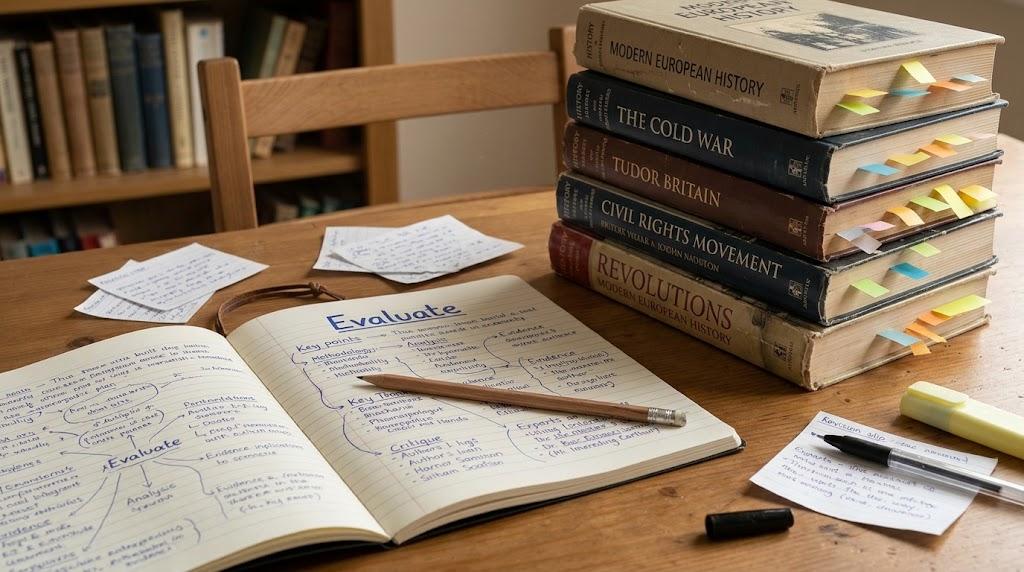
You know the content. You have the flashcards, the colour-coded notes and a decent grip on the dates, theories and case studies. Then the paper says evaluate, and your mind goes blank.
It happens to nearly every candidate at some point. The knowledge is there, but it comes out as a long account of what happened rather than an argument about what it means.
The good news is that evaluation follows a pattern. Once you can see it, you can use it in History, Sociology, Business, Geography, English Literature and most other subjects.
Take this GCSE History question: To what extent was the Treaty of Versailles responsible for the Second World War?
Most candidates begin by listing what the treaty did: lost territory, army limits, reparations. All accurate. None of it answers the question.
The question asks you to weigh the treaty against other causes, such as Hitler’s foreign policy, the Great Depression and the weakness of the League of Nations. Describing the treaty is only the starting material.
Command words signal the job:
Boards differ in the detail, but evaluation always ends in a judgement you can defend.
Here is something many essay guides skip. Before you judge anything, decide what you are measuring it against.
“Effective” means nothing on its own. Effective at what? A policy might succeed in cutting unemployment and fail to improve living standards. Both statements are true, so the yardstick changes the verdict.
Try writing your yardstick in one line at the top of your plan. For a Business question on price cuts, it might be: “Success means higher profit, not just higher sales.”
In English Literature, it might be: “I am judging how far Shakespeare makes Macbeth responsible for his own fall, not just what happens to him.”
That sentence stops you drifting into description and gives every paragraph something to test the evidence against.
At A-Level, mark schemes lean heavily on sustained judgement. Naming your criteria and applying them consistently shows the independent thinking that separates a B from an A.
Knowing the subject well does not automatically mean you can evaluate it well. Students who have revised extensively often have so much information available that they struggle to decide which points deserve attention.
A School Essay Writing Service UK can show you what a finished argument looks like, but it cannot sit the exam for you. The unseen essay in the hall rewards thinking habits you build yourself.
Three patterns cost marks again and again.
Balance mistaken for equal space. A balanced essay is not a 50/50 split. If one cause directly triggered an event and another only made it possible, equal space distorts their importance. Balance means weighing alternatives fairly, not pretending they carry equal weight.
Evidence mistaken for proof. A date, statistic or quotation does not establish your argument by itself. Evidence needs interpreting, and it often reveals a limit as well as support.
Judgement saved for the end. A conclusion cannot rescue paragraphs that only describe. Test the strength of each argument as you develop it, so your final judgement grows out of the discussion.
Use a simple chain: point, evidence, so what, but, therefore.
Here is a weak paragraph: “The treaty reduced Germany’s army to 100,000 men. This made Germans angry.”
Now a stronger one:
“The treaty capped Germany’s army at 100,000 men, which many Germans saw as a national humiliation. That resentment handed extremist parties a ready-made grievance. However, resentment alone did not start a war. Hitler’s decision to rearm and the policy of appeasement turned bitterness into action. The treaty therefore created the conditions, but other decisions supplied the trigger.”
The difference is not that the second version contains more information. It uses the evidence to test two connected claims. The army limits support the idea that the treaty created resentment, but they cannot prove resentment alone caused war.
Ask three questions whenever you introduce an example:
Every main paragraph should end on a judgement that links back to the question, not on another fact.
A few minutes of planning save a surprising amount of rewriting. Five minutes suits a 45-minute essay, but it is not a fixed rule, so adjust it to your paper. The aim is not a perfect plan. It is to know what you are arguing before you start.
That one-sentence answer is your thread. Every paragraph should either support it or test it.
In Sociology, your limits might involve sample size; in English Literature, alternative readings. The method stays the same.
Underline your judgements. After practising an essay, underline every sentence that weighs importance. If you only underlined two, add more.
Fix one weak judgement. Take this: “The treaty was the most important cause of the war because it made Germany angry.” It claims a lot without comparing anything. Try: “The treaty fuelled resentment, but Hitler’s later decisions turned it into aggression, so it was an underlying cause rather than the immediate one.” Notice how it separates a background condition from a trigger.
Read each paragraph cold. Ask: “So what does this tell me about the question?” If you cannot answer, the examiner will not be able to either.
Concede honestly. Admitting a weakness in your own argument makes your final judgement more credible.
Practise in short bursts. Plan a past question, then write only the opening paragraph and the final judgement.
Evaluation is not about writing more. It is about choosing a yardstick, weighing evidence against it and committing to a judgement you can defend.
GCSE candidates should aim for a supported judgement in every main paragraph. A-Level candidates should go further, comparing interpretations and testing whether their argument survives when other factors are added.
The strongest essays are not the longest. They are the ones where every paragraph knows what it is arguing.