English
 Arabic
 French
 Spanish
 Portuguese
 Deutsch
 Turkish
 Dutch
 Italiano
 Russian
 Romaian
 Portuguese (Brazil)
 Greek

Polymerization Initiators Market Outlook Strengthens Through 2033
Health |
2026-10-06 06:27:26
You finish the draft and read it back. The research is solid. The points make sense. Yet something feels off.
An example arrives too late. A paragraph drifts away from the question. The conclusion sounds like it belongs to a different essay.
Here is the thing: the problem is not always the writing itself. Sometimes, the ideas are perfectly sound, but the order makes them harder to follow.
A paragraph may contain exactly the right information and still weaken the discussion because it appears too early or too late. The good news is that structure can often be improved without tearing the whole assignment apart.
Assignments are rarely written in the order they are read. You research on Monday, add a source on Wednesday, rework the intro on Friday. By the end, the draft records how you thought rather than guiding the reader.
That gap matters more at Levels 5 and 6, where markers reward comparison, evaluation and evidence-based reasoning over description. At master’s level, they also expect you to weigh competing views and admit where your own argument has limits.
The order in which you researched your ideas is not necessarily the order in which a reader needs to encounter them.
Most structural problems look harmless at first glance.
The late limitation. A paragraph explains a motivation model, then three paragraphs later admits its biggest weakness. Every line is accurate. The reader just waited too long for the point that changes how the model reads.
The echo. An idea appears in the intro, returns in the middle and is repeated almost word for word in the conclusion. It feels like reinforcement. To a marker, it may look as though nothing new was added.
The crowded paragraph. One block defines a theory, traces its history, compares two authors and adds an example. Four jobs, one paragraph, no clear purpose.
The reference parade. Five sources stacked in a row, with no comment on where they agree or clash. That is a list, not an argument.
The mismatch. The introduction promises one direction, but the body follows another. This often happens when research changes your understanding halfway through.
Three ideas catch different faults.
Unity: does each paragraph do one job? Several points are fine if they all serve the same purpose.
Coherence: can the reader see why the evidence supports the point? Stating a finding is not the same as explaining what it shows.
Progression: is the discussion moving forward? Five theories introduced one after another is a tour, not a critique.
Proofreading fixes spelling and grammar. Language editing smooths sentences. Structural editing reorders and tightens the argument.
The distinction also explains why different forms of academic editing should not be confused. A Best Coursework Editing Service, for example, may be associated with proofreading, language correction or structural editing, but these address different aspects of a written assignment. Improving sentence clarity will not automatically resolve a poorly organised argument, just as rearranging paragraphs cannot make an unsupported claim convincing.
It is also worth checking your university’s academic integrity policy before using outside editing support. Institutions can differ in what they permit, particularly when assistance goes beyond correcting grammar and spelling. Make sure any editing you use is consistent with your course requirements and does not replace work you are expected to complete independently.
Then return to the assessment question itself. After weeks of reading, it is easy to forget what was asked. An interesting paragraph that does not help answer it needs rethinking, however well written.
Think about the relationship between a claim and its evidence, too. If the supporting source appears several paragraphs later, the reader has to hold the claim in mind while waiting for the explanation. Keeping related material close together often makes the reasoning easier to assess.
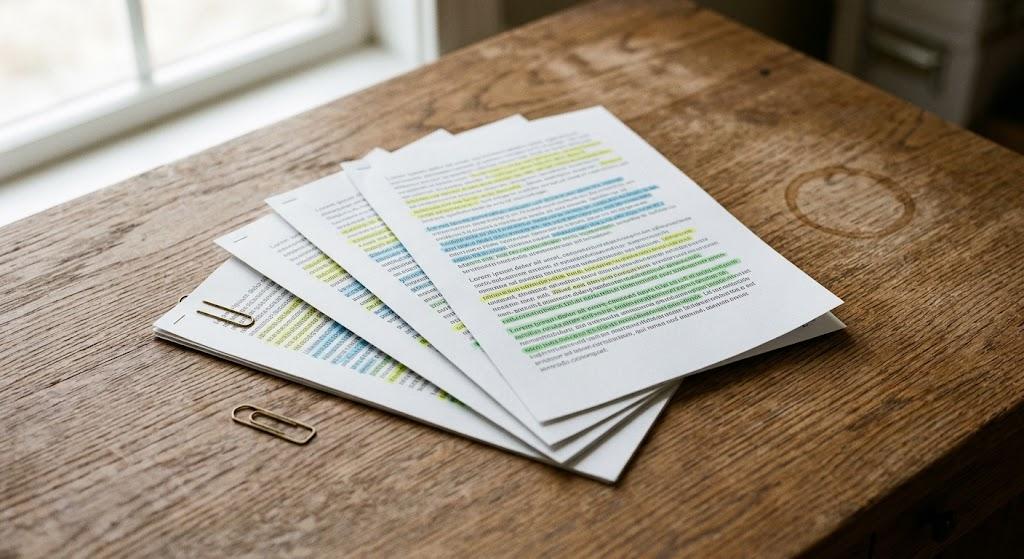
Here is a method many guides skip. Print the draft, or use the highlighter on screen.
Mark every sentence in one of three colours. Yellow for claims. Blue for evidence. Green for explanation, meaning the sentence that says what the evidence demonstrates.
Now look at the page. A paragraph full of blue and no green may be a source dump. All yellow and no blue is opinion. No yellow at all suggests the paragraph has no clear point.
A paragraph with no green may not have finished its argument. Try adding an explanation of what the evidence actually demonstrates. In some paragraphs, one or two sentences may be enough; others may need a clearer connection between the evidence and the main claim.
Even a short pass through the assignment can reveal problems that ordinary rereading tends to miss.
Next, write one sentence beside each paragraph saying what it contributes. Not the topic, the contribution. “Employee motivation” is a topic. “Shows why recognition affects engagement” is a contribution.
Then read only the first sentence of every paragraph. Do they form a sensible outline?
Do not move a paragraph just because it looks out of place. Read the one before it and the one after it. Sometimes the real weakness is a missing linking explanation, and a short connection solves it without disturbing the rest.
Before: “Employee motivation is affected by several factors. Herzberg identifies hygiene factors and motivators. Employees value recognition. Poor communication creates dissatisfaction.”
After: “Motivation depends partly on working conditions and partly on achievement. Herzberg separates hygiene factors, linked to dissatisfaction, from motivators, linked to satisfaction. That explains why better conditions alone rarely produce lasting engagement, although recognition and communication still shape how staff experience work.”
Same ideas. No fancier vocabulary. Each sentence now leans on the one before it.
Editing everything at once. Reorder first, refine language later. Otherwise you cannot tell what helped.
Deleting all repetition. A conclusion should return to the main argument, but as a synthesis, not a copy.
Hiding weak links behind “however”. A transition needs a real contrast behind it.
Cutting limitations to sound confident. Acknowledged limits usually read as stronger thinking, not weaker.
Moving a quotation away from its context. Meaning can shift once the surrounding explanation is gone.
Good structure means the reader never has to guess why an idea appeared.
Start with the question, give every paragraph a job, and check the order. Keep a “parking” document for anything you cut, so nothing feels risky. Leave alone any sentence that already works.
Your position, reasoning and voice should come through the edit untouched. If a reader can follow the argument without working out what you meant to connect, the structure has done its job.