English
 Arabic
 French
 Spanish
 Portuguese
 Deutsch
 Turkish
 Dutch
 Italiano
 Russian
 Romaian
 Portuguese (Brazil)
 Greek

Where Can You Book a Comfortable Homestay in Connaught Place Today?
Home |
2026-10-21 06:21:42
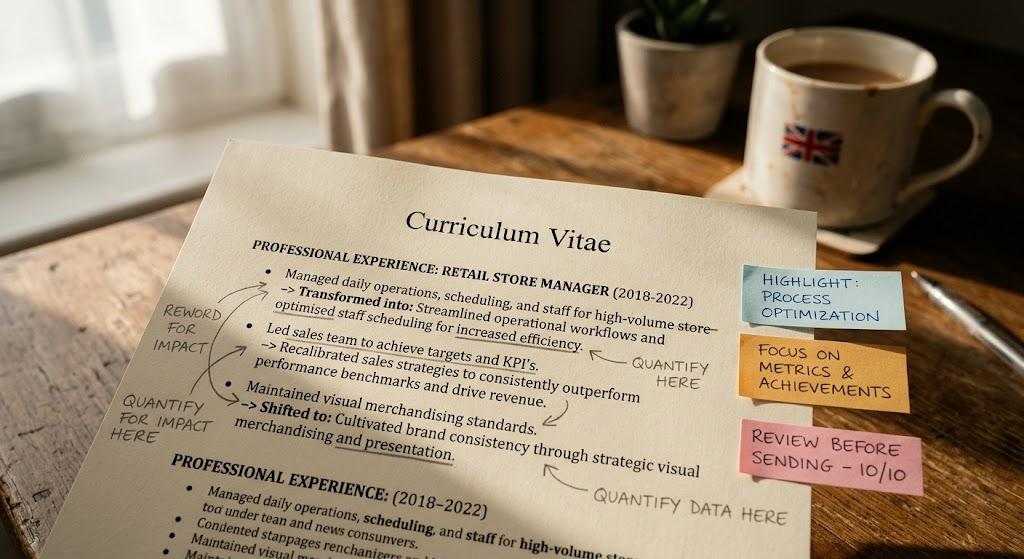
You have years of solid experience behind you. Yet the job you want now looks nothing like the one you have been doing.
Perhaps it is retail to office administration, or restaurant management to HR. Either way, the same worry follows: how do you make that experience matter in a completely different field?
Most people go one of two ways. They pack in every detail of the old job, or they dress it up in jargon they have never used. Neither works.
The better route is simpler. Show what your experience has taught you, where it connects to the new role, and where you are already closing the gap.
A job title tells an employer where you stood. It says very little about what you can actually do.
Take a restaurant supervisor aiming for office management. It looks like a huge leap. Yet in a normal week that person handled rotas, supplier calls, stock records, complaints and last-minute absences.
Remove the restaurant setting and what remains is coordination, record-keeping, communication and quick decisions. Those are office skills in every sense.
The same applies to a teacher moving into corporate training. Planning sessions, explaining difficult ideas and checking progress is training work already.
Your job title describes where you worked. Your responsibilities show what you can do. A career-change CV should lead with the second.
Different industries describe the same work in different words. What one sector calls rota management, another calls workforce scheduling.
If your CV only uses the old label, a recruiter searching for the new one may simply move on. That can be the real reason a capable person hears nothing back.
Then there is overstating. Calling yourself a project manager because you organised daily staff duties invites questions about budgets, timelines and risk. Those questions expose the gap fast.
And there is over-explaining. Ten years in retail does not need ten years of detail. Give your space to the experience that supports the job you want, not the one you are leaving.
A career break does not cancel the experience you gained before it. If the gap needs explaining, a brief, factual note is usually enough; there is no need to share private family or personal circumstances. You can also mention relevant training, volunteering or projects from that period, provided they genuinely show something useful for the role.
Changing careers makes people question how their experience should look on paper. Even someone with years of success behind them may struggle to explain why their background suits a different position. Searches such as Write My CV for Me reflect that difficulty, but the real starting point is simpler: identifying the responsibilities, decisions and achievements that show what you can bring to a new role.
Here is a method that does the heavy lifting. Take a live vacancy and pull out its five most important requirements. For each, make three notes:
Say the advert asks for “coordinating interview schedules”. Your proof: building weekly rotas for 18 staff around holidays and sickness. Your bridge: “Coordinated schedules for a team of 18, adjusting daily around absence and demand.”
Nothing was invented. It was only translated.
If you cannot fill in the proof column for a requirement, you have found a genuine gap. That is useful to know before an employer finds it for you.
Not all evidence carries equal weight. Think of it as three rungs:
Employers trust the top rung most, so label each skill honestly. Someone moving into digital marketing might have a short course (learned) and a small campaign for a local charity (practised). Both belong on the CV. Neither should be presented as years of experience.
If a skill is new to you, practical evidence makes your application more convincing. A small project, volunteering responsibility or freelance task shows you can apply what you have learned. This matters most when your professional experience does not yet cover a requirement. A certificate shows you have studied the subject; practical work shows you have started using it.
Begin with a profile that says something. Skip lines about being hardworking or seeking a new challenge. State what you have done, where you are heading and what supports the move.
For example: “Retail supervisor with experience in staff coordination, daily reporting and customer issue resolution. Seeking an office administration role, supported by recent business administration training.”
In your employment history, keep the real job titles, employers and dates. Change only the selection and wording of responsibilities.
Original: “Responsible for dealing with customer complaints.”
Reworked: “Resolved customer concerns by assessing each situation, explaining options and maintaining service standards.”
Add achievements where they are real, and use figures only if you can back them up.
Finally, tailor every application. You rarely need to rewrite everything. Adjust the profile, move the most relevant achievements up and reorder your skills.
For many UK professional applications, a two-page CV is a practical length, although the right size depends on your experience and the role. A photograph is not generally expected. Give particular attention to the opening section: your profile and most relevant experience should make the link between your previous work and the new role clear without making the reader search for it.
A change of profession can make years of work feel strangely hard to explain. You may have managed people and handled pressure, yet struggle to describe your value to someone new.
But your history does not lose its worth because your direction has changed.
Some connections will be obvious. Others need a sentence of explanation. A few will be real gaps, to be closed with training or practical work. All of that is normal.
You do not need to prove your old career was the same as your next one. You need to show why what you have learned makes the next step credible. Start today with one vacancy and one page of notes.