English
 Arabic
 French
 Spanish
 Portuguese
 Deutsch
 Turkish
 Dutch
 Italiano
 Russian
 Romaian
 Portuguese (Brazil)
 Greek

Event Organizer in Karachi: Creating Memorable Events with Professional Planning
Art |
2026-11-12 08:03:44
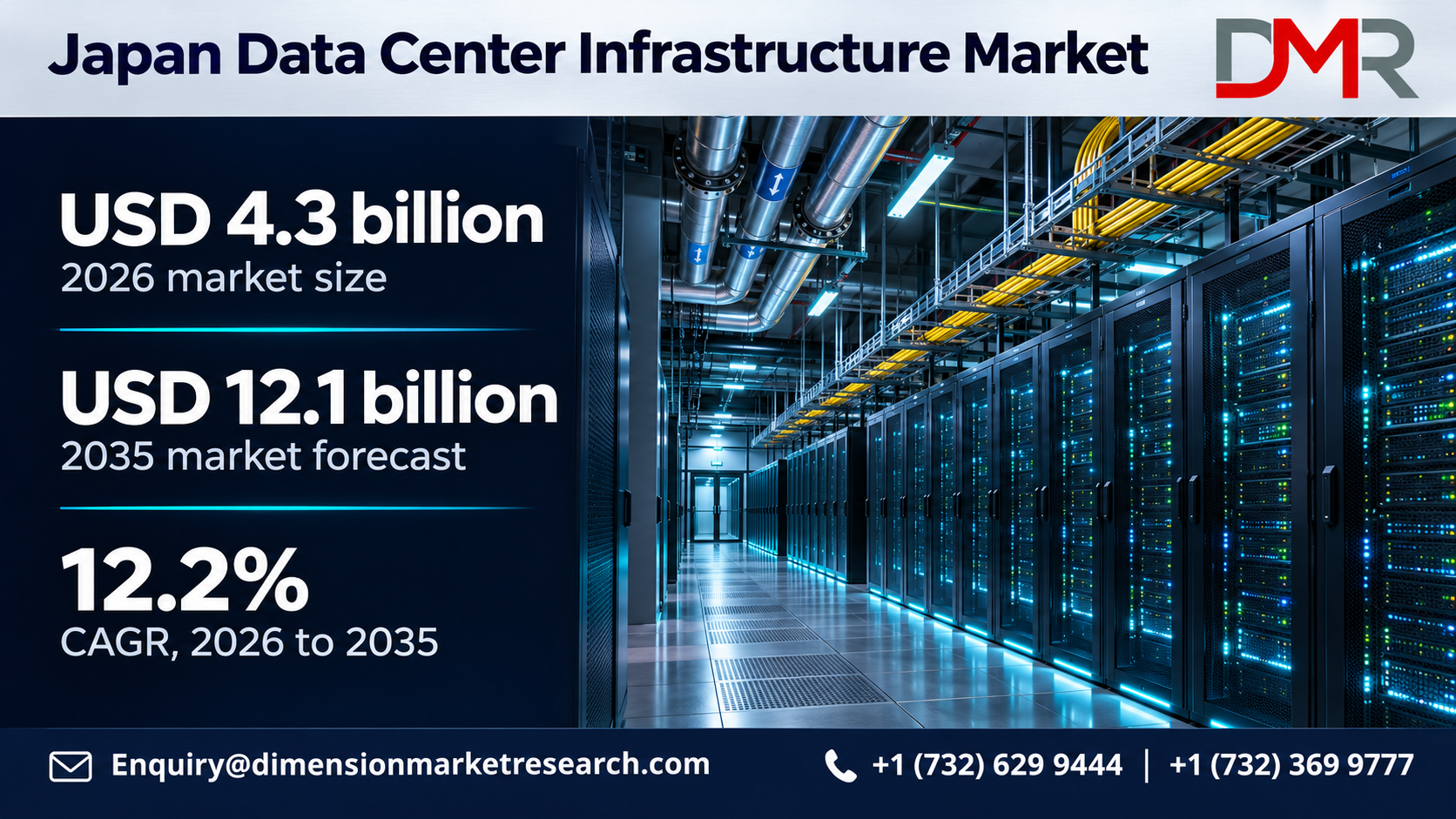
According to Dimension Market Research, the Japan Data Center Infrastructure Market is estimated at USD 4.3 billion in 2026 and projected to reach USD 12.1 billion by 2035, at a CAGR of 12.2%. Cloud expansion is driving demand for servers, storage, and networking, while denser AI workloads are changing what facilities need from their power and cooling systems. In Tokyo and Osaka, access to suitable land and reliable power can influence where and when new capacity comes online.
IT infrastructure is projected to account for 38.7% of market revenue in 2026, the largest share by component. The segment includes servers, storage systems, and networking equipment. Cloud and enterprise upgrades support demand across all three, while AI and high-performance computing increase demand for GPU servers and faster connections between systems. For suppliers, that means a computing upgrade can create demand for several equipment categories within the same facility.
DMR identifies cooling infrastructure as the fastest-growing component segment. As operators install more computing capacity per rack, they must manage the additional heat. The report points to direct-to-chip liquid cooling and coolant distribution units as areas of adoption. For operators assessing a retrofit, the decision includes whether the new cooling equipment can work with the facility’s existing power, layout, and maintenance arrangements.
Review how the report segments demand by infrastructure component, facility type, deployment model, organization size, and end user. Operators, equipment suppliers, and investors can use the sample to identify the categories most relevant to a facility build, retrofit, or product launch.
https://dimensionmarketresearch.com/request-sample/japan-data-center-infrastructure-market/
Hybrid deployment is projected to lead the deployment breakdown in 2026, while hyperscale data centers are expected to lead by facility type. These figures describe different decisions. Hybrid deployment reflects how enterprises distribute workloads across environments. Hyperscale describes the kind of facility built to support large computing requirements. An enterprise can retain some workloads in its existing environment while moving others to cloud infrastructure hosted in a hyperscale facility.
Large enterprises lead the organization-size segment, and IT and telecommunications account for a projected 30.7% of 2026 revenue by end user. DMR links the latter segment’s position to cloud expansion, 5G deployment, AI applications, and demand for enterprise connectivity. Those buyers can create opportunities for both equipment used in large facilities and modular systems deployed closer to customers.
Reliable grid connections and suitable land can take time to secure in major metropolitan areas. Earthquake-resistant construction, backup power, and advanced cooling also add to project complexity. These constraints affect whether organizations build their own capacity, expand an existing site, or use a colocation provider. Regional and edge facilities offer another opportunity where industrial automation, 5G, or other applications benefit from processing data closer to users.
The report covers NTT DATA Group, KDDI, Fujitsu, NEC, Schneider Electric, Vertiv, Equinix, and Digital Realty, among others. The list spans operators, technology providers, and equipment suppliers. For vendors selling into Japan, a large cloud facility and a regional edge site can require different combinations of power capacity, cooling, installation support, and room for expansion.
Compare component demand, deployment models, facility types, and end-user segments to assess opportunities in computing equipment, power, cooling, and modular infrastructure.
https://dimensionmarketresearch.com/checkout/japan-data-center-infrastructure-market/
DMR estimates USD 4.3 billion in 2026 and projects USD 12.1 billion by 2035.
The market is projected to grow at a CAGR of 12.2% from 2026 to 2035.
IT infrastructure leads with a projected 38.7% revenue share in 2026.
DMR identifies cooling infrastructure as the fastest-growing component segment, supported by rising heat density from AI workloads.
IT and telecommunications lead with a projected 30.7% revenue share in 2026.
Cloud adoption and enterprise modernization are driving demand for IT equipment, while AI workloads are increasing the need for facilities that can support denser racks. Through 2035, opportunities extend from cooling upgrades at existing sites to modular infrastructure for regional facilities. The pace of expansion will depend in part on access to power and the ability to integrate new equipment into operating facilities.
The global Data Center Market Size report projects growth from USD 301.8 billion in 2026 to USD 805.3 billion by 2035 at an 11.5% CAGR. It provides a broader view of how cloud adoption and higher-density workloads affect facility investment.
The Data Center Services Market Share report projects colocation services to lead the service-type segment with a 40.0% share in 2025. It forecasts the overall services market to reach USD 107.7 billion by 2034.
The AI Data Center Market Growth report projects a 28.5% global CAGR from 2026 to 2035. It identifies cloud service providers as the leading end-user segment in 2026 and examines facilities built to support AI workloads.