English
 Arabic
 French
 Spanish
 Portuguese
 Deutsch
 Turkish
 Dutch
 Italiano
 Russian
 Romaian
 Portuguese (Brazil)
 Greek
Warm Luxurious Minimalism: Showcasing Major Carat Radiance in a Traditional Gold Solitaire Engagement Ring Sourced with Certified Three Carat Diamonds
Shopping |
2026-10-31 08:12:31
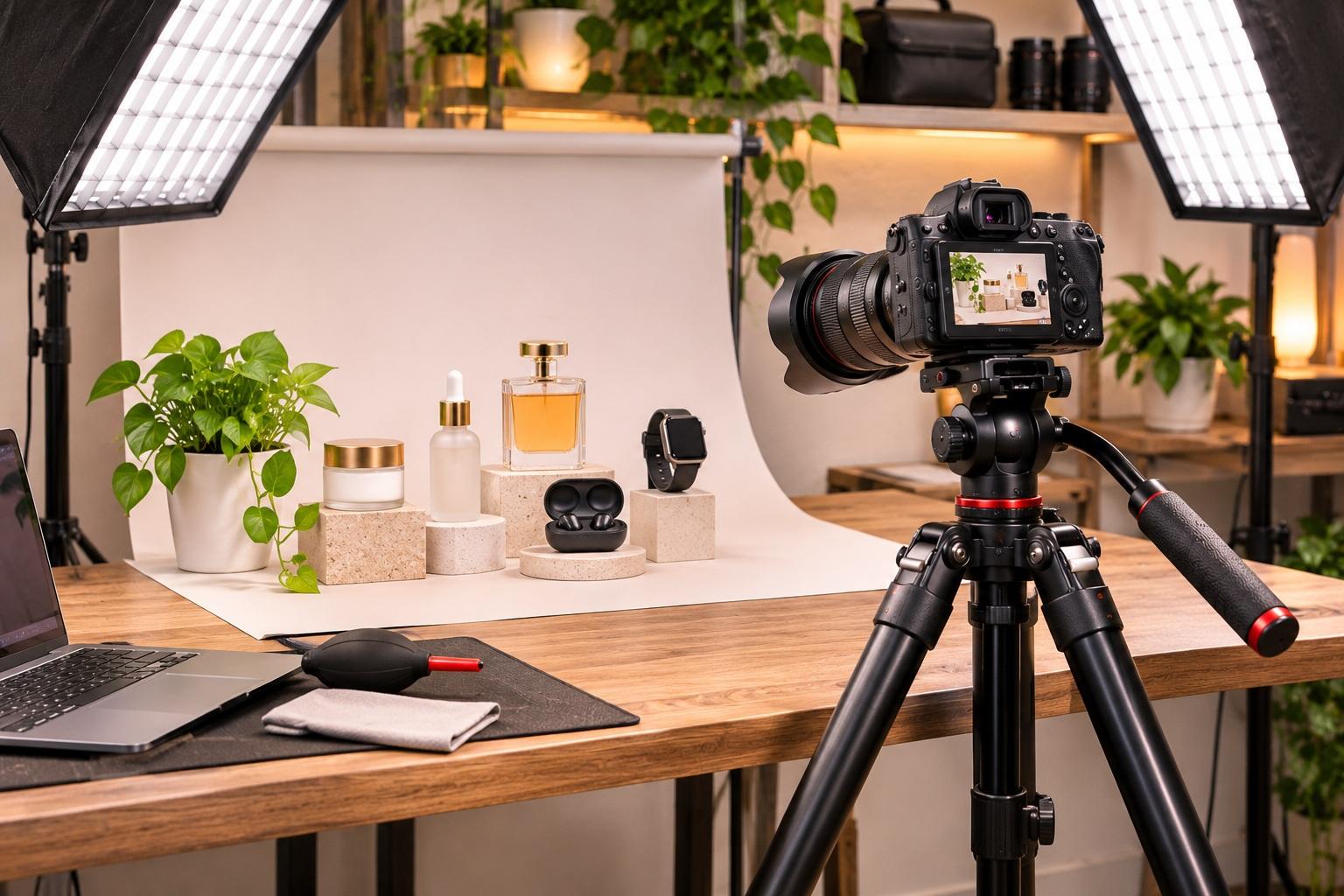
You do not need a large commercial studio to create professional-looking product images. Many ecommerce sellers, small businesses, freelancers, and content creators now photograph products from bedrooms, spare rooms, offices, and compact home studios.
What matters is control.
A stable tripod stand helps keep the camera position consistent while you adjust lighting, move products, change backgrounds, or capture several images of the same item. For indoor product photography, that consistency is often more important than having the tallest or most portable tripod available.
The best setup for home use should combine stability, a manageable footprint, precise camera positioning, useful working height, and enough load capacity for your camera and lens. If you also shoot flat lays, overhead capability becomes even more valuable.
This guide explains what actually matters when choosing a tripod for product photography at home.
Product photography often involves careful, repeatable compositions.
You may need to photograph:
Cosmetics
Watches
Jewelry
Mobile accessories
Headphones
Small electronics
Perfume bottles
Shoes
Bags
Kitchen products
Ecommerce packaging
If you photograph handheld, even small changes in camera position can alter perspective, framing, and background alignment.
A tripod keeps the camera fixed while you change the product or lighting.
This is particularly valuable when creating catalog images where every photograph should have a similar composition.
Current studio product-photography guidance also emphasizes repeatability because product work frequently involves batches, multiple exposures, focus stacking, or carefully controlled compositions where camera movement can create extra editing work.
Travel photographers often care about folded size and weight.
Home product photographers usually have different priorities.
If your tripod spends most of its time in one room, slightly heavier construction may actually be useful because it can provide a more stable base.
Look for:
Strong leg sections
Reliable leg locks
Minimal movement at the joints
Non-slip rubber feet
A secure center column
A tripod head that stays locked
For product photography, the tripod should remain exactly where you position it while you adjust props, lighting, or styling.
Recent product-photography comparisons consistently identify stability and precise camera positioning as more important than headline specifications alone.
Before choosing a tripod, look at the room where you actually shoot.
A home studio might include:
A desk
Small product table
Backdrop stand
Two LED lights
Softbox
Reflector
Laptop for tethered shooting
Once those items are added, floor space disappears quickly.
A very wide tripod may become difficult to position around a small table.
For a compact home studio, consider:
How far the legs spread
Whether the center column can reposition
How close the tripod can move to the table
Whether the camera can angle downward easily
Whether you can walk around the setup safely
Hope Enterprises' guide to a photo studio setup is also useful when planning how camera support, lighting, backgrounds, and working space fit together.
Both can be useful, but they serve different types of product work.
A full-size tripod is usually the better all-round option if you photograph different product sizes.
It works well for:
Shoes
Bags
Electronics
Bottles
Boxes
Clothing accessories
Small furniture products
It also gives you more freedom to change shooting height and camera angle.
A tabletop tripod can work well for:
Jewelry
Watches
Small cosmetics
Mini gadgets
Close-up detail photography
Current tabletop tripod guidance suggests compact supports work best for small products when working height is limited, while larger products and overhead compositions generally need taller or more flexible support.
If you intend to photograph many different products, a full-size tripod usually gives you more room to grow.
Not every home product shoot is photographed from the front.
Flat lays are popular for:
Accessories
Cosmetics
Clothing
Watches
Stationery
Product bundles
Social media content
Ecommerce promotional images
For this kind of work, a tripod with a horizontal or pivoting center column can be extremely useful.
Instead of placing the camera directly above the tripod legs, the center column extends toward the table so the camera can point downward.
Current overhead-photography guidance commonly recommends horizontal center columns, pivoting columns, boom-style supports, or dedicated overhead systems for flat lays and tabletop products.
This is especially useful in small rooms because the tripod can remain beside the table instead of occupying the shooting area.
Do not look at camera-body weight alone.
Your tripod may need to support:
Camera body
Lens
Quick-release plate
Camera cage
Macro accessories
External monitor
Phone holder
Product photography may use standard zooms, macro lenses, or heavier lenses depending on the subject.
Choose a tripod with enough capacity to support the complete system comfortably.
Do not plan to work continuously at the maximum advertised payload.
A stronger margin generally gives you better confidence when adjusting the camera, especially if the center column moves horizontally.
Product photography often requires more precise framing than fast event photography.
The head you choose can make small adjustments much easier.
A ball head is quick and flexible.
It is useful if you frequently move between:
Straight-on product images
Angled shots
Detail shots
Flat lays
A good ball head should remain completely stable after locking.
A three-way head allows you to adjust horizontal, vertical, and tilt movement separately.
This can be useful for carefully aligning:
Bottles
Product boxes
Packaging
Architecture-style product compositions
A geared head allows very small positioning adjustments.
It can be particularly valuable for:
Jewelry
Macro product photography
Technical photography
Highly repeatable catalog work
Recent product-photography comparisons often recommend ball heads for speed and geared or three-way heads when very precise alignment is more important.
For most home creators, a solid ball head is a practical starting point.
You do not necessarily need the tallest tripod available.
Instead, think about the products you photograph most frequently.
For example:
Small jewelry may require a low camera position.
Bottles may need slightly elevated angles.
Shoes and bags may need standard tabletop height.
Larger boxes may require greater height.
Flat lays may require the camera to move well above the table.
A tripod with flexible height adjustment gives you more control than one optimized only for maximum height.
You should also check the minimum working height.
Low-angle capability can be useful for dramatic product photographs or macro work.
A center column provides extra height, but extending it too far can make the setup less rigid.
For ordinary tabletop product images:
Set the tripod legs to the correct height first.
Keep the center column relatively low.
Use the column only for small framing adjustments.
For overhead work, the center column may need to move horizontally, so balance becomes even more important.
The farther the camera moves away from the center of the tripod, the more carefully the setup should be supported.
Current overhead-tripod guidance warns that lateral reach changes the center of gravity and that safe balancing matters as much as nominal payload.
A common mistake is placing the tripod first and then trying to fit everything else around it.
Instead, plan the entire shooting area.
A simple home product setup may work like this:
Product table in the center
Leave enough room to style and rotate the item.
Camera and tripod in front or to one side
Keep enough distance for the lens you use.
Key light at approximately 45 degrees
This provides shape and texture.
Reflector or fill light opposite the key light
Use it to control shadows.
Backdrop behind the product
Keep it far enough away to avoid distracting shadows when possible.
Hope's guide to professional photo studio equipment provides additional context for combining camera support with lights, backdrops, and other studio tools.
Imagine photographing 20 products for an online store.
If every image is captured from a different height or camera angle, the final collection page can look inconsistent.
A tripod lets you:
Fix camera height
Maintain perspective
Keep the product centered
Reuse the same background
Match several product images
Simplify editing
This is especially useful for businesses photographing several versions of the same product.
For example, if you sell one accessory in five colors, keeping the camera fixed allows you to replace only the product while maintaining nearly identical framing.
That can make your ecommerce catalog appear much more professional.
Small products sometimes need more depth of field than a single photograph can easily provide.
In macro or close product photography, photographers may capture several images focused at different points and combine them later.
This is known as focus stacking.
The camera must remain stationary between frames.
Product photography can also involve multiple exposures when:
Combining different lighting positions
Creating composites
Photographing reflective products
Capturing different highlights
A tripod makes these techniques much easier because framing remains consistent.
If you also record product videos, consider the tripod head carefully.
A ball head is useful for setting a fixed composition, but it is not designed for smooth controlled video movement.
For product videos involving slow:
Pans
Tilts
Reveals
a fluid video head is usually better.
If most of your content is photography, prioritize precise locking.
If photography and video are equally important, you may want a more hybrid setup.
A tripod can also interfere with lighting if the room is small.
Before buying a very large model, think about where your light stands will be positioned.
You should have enough room to place lighting:
Beside the product
Slightly behind it
Above it
Opposite a reflector
For creators building a compact home studio, Hope's guide to starting a photography studio with minimal gear in Pakistan can help keep the overall equipment setup practical rather than unnecessarily complicated.
For indoor product photography at home, prioritize these features:
The camera should remain fixed throughout the shoot.
You need enough flexibility for small and medium products.
The composition should stay locked after adjustment.
Especially useful for flat lays and overhead shots.
Important for small home studios.
Your camera, lens, and accessories should be comfortably supported.
Useful when moving between tripod and handheld shooting.
Helpful for close-up or creative product images.
Especially useful on tile, wood, or smooth indoor floors.
Indoor product photography needs positioning flexibility more than extreme height.
A lightweight tripod may become less stable with heavier lenses or an extended horizontal column.
Strong legs cannot compensate for a head that slowly slips.
Measure your working area before choosing.
If flat lays are part of your content plan, horizontal positioning can save you from buying a second support system later.
If you need consistent ecommerce images, keep the tripod position fixed and adjust the products instead.
For small ecommerce sellers, choose a stable full-size tripod that does not occupy too much floor space.
For jewelry and cosmetics, prioritize precise head control, low-angle capability, and overhead flexibility.
For phone-based creators, a compact support may be sufficient if it securely holds the device.
For mirrorless or DSLR users, prioritize stronger legs, a dependable head, and higher load capacity.
For flat lay creators, a horizontal or pivoting center column should be high on your feature list.
For catalog photographers, consistency and repeatability matter more than portability.
The best tripod stand for indoor product photography at home should help you maintain consistent framing while fitting comfortably into your available space.
Prioritize stability, usable height, tripod-head quality, compact floor footprint, and enough load capacity for your camera setup.
If you create flat lays, look for horizontal positioning. If you shoot large batches of ecommerce products, prioritize repeatable camera placement. If you also shoot video, consider whether a fluid head would improve your workflow.
For most home photographers, a versatile full-size tripod provides the best balance because it can handle straight-on product photographs, angled compositions, close-ups, flat lays, and video without requiring a completely different support for each task.
The right tripod does more than prevent camera shake. It helps turn a small home workspace into a repeatable and efficient product photography setup.
A stable full-size tripod with an adjustable height range, strong head, compact footprint, and optional horizontal center column is one of the most versatile choices for home product photography.
A tripod is especially useful for ecommerce catalogs, low-light setups, focus stacking, multiple exposures, and any shoot where consistent framing is important.
Yes, tabletop models can work well for jewelry, cosmetics, watches, and other small objects. A full-size tripod offers more flexibility if you photograph products of different sizes.
A ball head is versatile and fast, while three-way and geared heads provide greater precision. The best choice depends on how exact your compositions need to be.
Not for every product, but overhead capability is very useful for flat lays, accessories, product bundles, cosmetics, clothing, and social media product content.