English
 Arabic
 French
 Spanish
 Portuguese
 Deutsch
 Turkish
 Dutch
 Italiano
 Russian
 Romaian
 Portuguese (Brazil)
 Greek
Executive Cab Service Los Angeles: Travel with Comfort, Style, and Confidence
Other |
2026-10-28 11:18:15
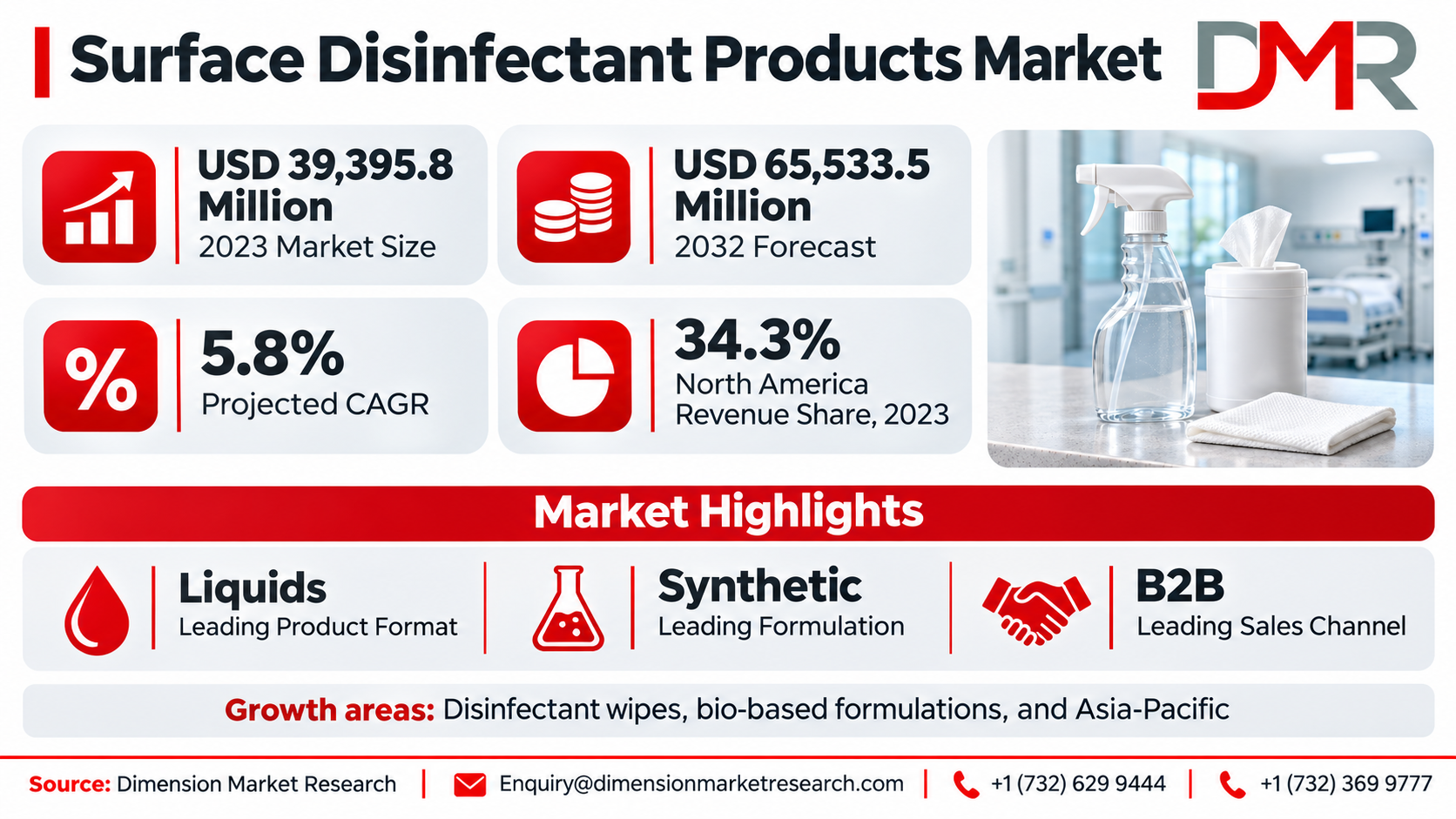
The Surface Disinfectant Products Market Size is projected to increase as healthcare facilities, businesses, and households place greater emphasis on hygiene. According to Dimension Market Research, the global market was estimated at USD 39,395.8 million in 2023 and is forecast to reach USD 65,533.5 million by 2032. The report’s detailed forecast lists a compound annual growth rate of 5.8% from 2023 to 2032.
For suppliers, the forecast raises two distinct questions. Which product formats fit how customers disinfect surfaces, and which regions offer room for expansion? The report’s findings on wipes, institutional purchasing, and Asia-Pacific healthcare demand help answer both.
The market covers liquids, sprays, and wipes formulated to disinfect surfaces. DMR segments these products by raw material, format, and distribution channel. Its raw material categories include synthetic, bio-based, and blended formulations. Customers range from hospitals, medical laboratories, and nursing homes to households that buy products through supermarkets, convenience stores, and online retailers.
Different cleaning tasks explain why these formats coexist. Facilities teams can use liquids with mops or cloths across larger areas, while ready-to-use wipes are convenient for frequently touched surfaces. For manufacturers, the task a product serves helps determine its format and the sales channel best suited to reach its buyers.
https://dimensionmarketresearch.com/request-sample/surface-disinfectant-products-market/
B2B was the largest distribution channel in 2023. DMR links its position to demand from hospitals, medical laboratories, and nursing facilities, where surface disinfection is part of routine infection prevention. The report also identifies applications in food processing, hospitality, and public facilities. For institutional suppliers, this range of customers makes it important to identify which settings suit each product format.
DMR also expects consumer sales to grow. Supermarkets and hypermarkets are important to this channel because shoppers can compare brands, formulations, pack sizes, and prices in one place. A supplier serving both channels may need to show institutional buyers how a product fits an established cleaning workflow while giving retail shoppers a clear reason to choose it from several formats on the same shelf.
The report identifies three important findings for product planning.
● Liquid disinfectants led by product format in 2023. Their versatility supports use across surfaces such as floors and walls, with equipment already common in facilities.
● Ready-to-use disinfectant wipes are projected to grow faster than liquids. Convenience supports their use in tasks where staff or consumers want a format that requires fewer supplies.
● Synthetic formulations led by raw material, while bio-based disinfectants are projected to grow faster. DMR also identifies biodegradable formulations and blends as areas of product development.
For portfolio teams, convenience and formulation present different decisions. A wipe can address a specific cleaning task within an existing liquid and spray portfolio. A bio-based product or blend calls for careful assessment of performance for the intended application. DMR also flags chemical exposure and regulatory compliance as considerations in product development.
● North America accounted for 34.3% of the market in 2023. DMR associates its leading position with healthcare spending, an established manufacturing base, and adoption by healthcare facilities, businesses, and households.
● Asia-Pacific is projected to grow at a higher rate over the forecast period. DMR links that outlook to greater hygiene awareness and broader adoption in hospitals and clinics. The report points to India as an example of healthcare adoption in the region.
For suppliers evaluating regional expansion, the findings point to different priorities. North America offers an established customer base across several settings. In Asia-Pacific, healthcare adoption gives suppliers a basis for assessing where their institutional product ranges fit demand.
The report lists companies including 3M, Procter & Gamble, Reckitt Benckiser Group PLC, Ecolab, and The Clorox Company. It also cites PDI’s introduction of disinfectant sprays and wipes in 2022 and SC Johnson’s launch of FamilyGuard spray and cleaner in April 2023. These examples show how suppliers use multiple formats to serve different cleaning tasks and customer preferences.
https://dimensionmarketresearch.com/checkout/surface-disinfectant-products-market/
DMR estimated the market at USD 39,395.8 million in 2023 and forecasts USD 65,533.5 million by 2032.
The report’s detailed forecast lists a CAGR of 5.8% from 2023 to 2032.
Liquids led by product format, supported by their versatility across surfaces and methods of application.
North America led with a 34.3% share in 2023.
Greater attention to hygiene and infection prevention across healthcare facilities, public spaces, businesses, and households is supporting demand.
Through 2032, DMR expects healthcare and wider hygiene demand to support the market. Liquids remain central to routine disinfection, while ready-to-use wipes offer an opportunity where convenience matters. Expanding healthcare infrastructure in Asia-Pacific gives suppliers another reason to assess where their formats and formulations fit institutional purchasing needs.