English
 Arabic
 French
 Spanish
 Portuguese
 Deutsch
 Turkish
 Dutch
 Italiano
 Russian
 Romaian
 Portuguese (Brazil)
 Greek
Premium Luxury Tea Cup Set – Elegant Fine China Tea Cups for Birthday & Wedding Gifts
Other |
2026-11-16 14:21:17
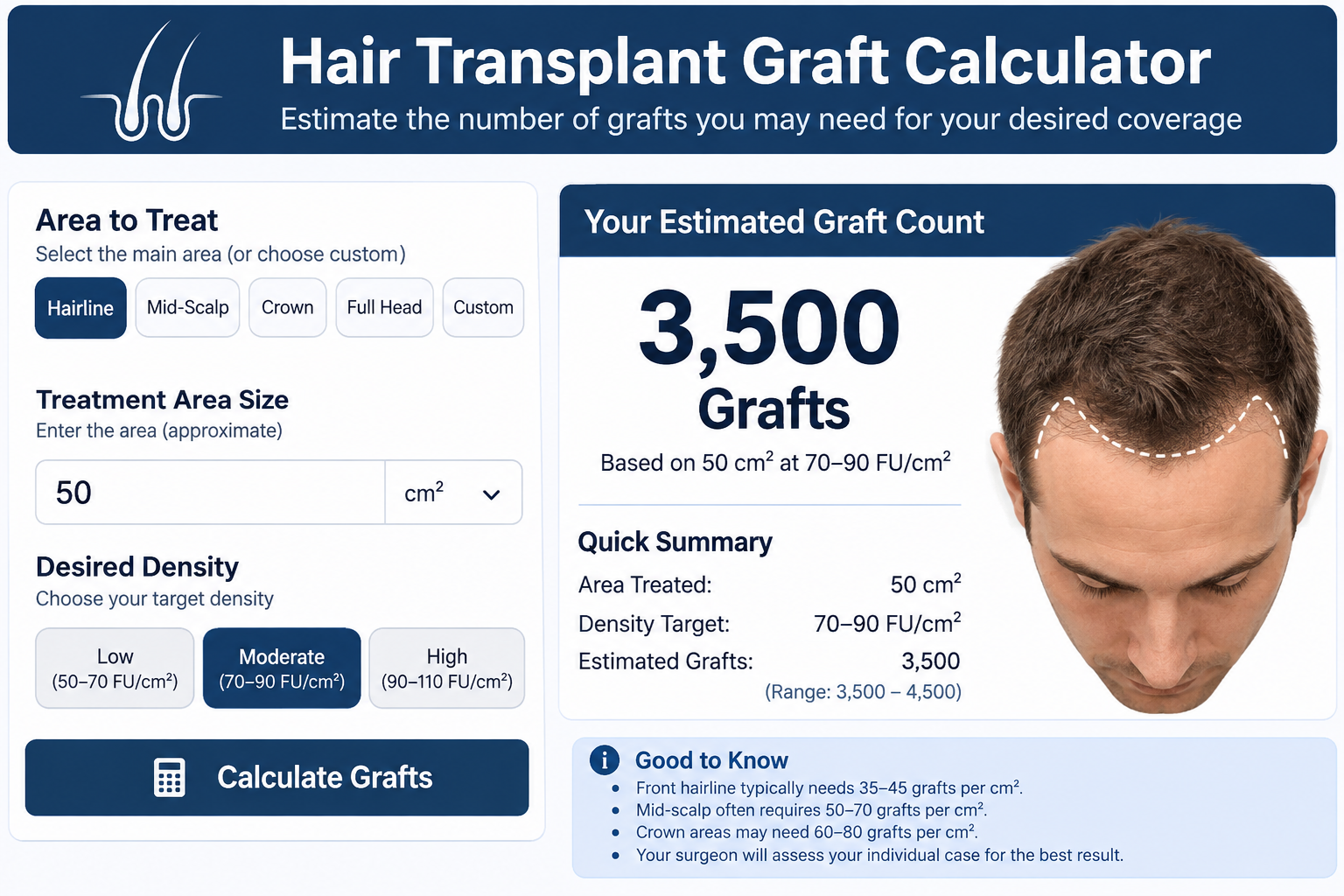
Hair loss can be a challenging experience for both men and women. Whether you are dealing with a receding hairline, thinning hair, a bald crown, or advanced hair loss, a hair transplant can help restore hair coverage and improve confidence. However, before choosing a hair restoration procedure, one important question needs to be answered: How many hair transplant grafts do you actually need?
An online Hair Transplant Graft Calculator can help you estimate the number of grafts required for your hair restoration journey. By considering the size of your hair loss area, desired hair density, and affected scalp regions, this tool provides an approximate graft count to help you plan your procedure.
In this guide, we will explain how an online Hair Transplant Graft Calculator works, how to estimate your graft requirements, and which factors influence the final number of grafts.
An online Hair Transplant Graft Calculator is a digital tool designed to estimate the number of follicular units needed for a hair transplant procedure.
A hair graft is a naturally occurring group of hair follicles that typically contains one to four individual hairs. During a hair transplant, these grafts are extracted from the donor area, usually located at the back or sides of the scalp, and implanted into areas affected by hair loss.
The calculator uses information about your bald area and desired density to estimate how many grafts may be necessary.
For example, someone with minor hairline recession may require fewer grafts than someone experiencing extensive hair loss across the frontal scalp, mid-scalp, and crown.
Although an online calculator cannot replace a professional medical examination, it provides a useful starting point for understanding your potential graft requirements.
Most online calculators use a simple mathematical formula to estimate graft requirements.
The basic formula is:
Required Grafts = Hair Loss Area (cm²) × Desired Graft Density (Grafts/cm²)
For example, suppose your affected scalp area measures 40 square centimetres and your desired density is 35 grafts per square centimetre.
40 × 35 = 1,400 grafts.
Based on this calculation, approximately 1,400 grafts may be required to cover the measured area at the selected density.
However, the actual graft requirement can vary depending on existing hair, scalp characteristics, donor availability, and the surgeon's treatment strategy.
Using an online Hair Transplant Graft Calculator offers several benefits for people considering hair restoration.
The calculator provides an initial estimate of how many grafts may be required for your affected scalp area.
This helps you understand the potential scale of your procedure before arranging a consultation.
Hair transplant prices are often calculated according to the number of grafts or through fixed treatment packages.
Knowing your approximate graft requirement helps you estimate potential expenses and compare clinic quotations.
Different clinics may recommend different graft numbers depending on their assessment and treatment strategy.
An online calculator gives you a preliminary reference point when reviewing treatment proposals.
Understanding your estimated graft requirements can help you develop realistic expectations about hair coverage and density.
It is important to remember that a successful hair transplant is not simply about implanting the highest number of grafts. Natural-looking results and donor area preservation are equally important.
The number of grafts required depends on the location and size of the affected scalp area.
Here are some general estimates:
|
Hair loss area |
Estimated grafts |
|
Temple restoration |
500–800 |
|
Minor hairline recession |
800–1,200 |
|
Frontal hairline |
1,200–1,800 |
|
Frontal and mid-scalp |
2,000–3,000 |
|
Crown restoration |
1,000–2,500 |
|
Extensive baldness |
3,000–5,000+ |
These figures are general estimates rather than fixed treatment recommendations. Your individual requirements may differ depending on hair characteristics, existing density, and donor hair availability.
An online Hair Transplant Graft Calculator provides an approximate result, but several factors influence the final number of grafts needed.
The size of your bald or thinning area is one of the most important factors.
A small receding hairline generally requires fewer grafts than extensive baldness involving multiple scalp regions.
Larger treatment areas usually require more grafts to achieve suitable coverage.
Hair density refers to the number of grafts implanted per square centimetre.
For example, a target density of 30 grafts per square centimetre requires fewer grafts than 40 grafts per square centimetre across the same area.
However, higher density is not always medically appropriate. The surgeon must evaluate blood supply, scalp condition, existing hair, and donor availability.
Hair thickness can influence the visual appearance of transplant results.
People with thicker hair shafts may achieve the appearance of fuller coverage with fewer grafts. Curly and wavy hair may also provide greater visual coverage compared with fine, straight hair.
The donor area is usually located at the back and sides of the scalp.
The quality, density, and availability of donor hair determine how many grafts can be safely extracted.
A qualified surgeon must evaluate the donor area carefully to avoid excessive harvesting and preserve options for future treatment.
Hair loss may continue after transplantation, particularly in individuals with progressive androgenetic alopecia.
A good treatment plan should consider potential future hair loss rather than focusing only on the areas currently affected.
Many people confuse the number of grafts with the number of individual hairs.
One graft typically contains one to four hair follicles. The actual number of hairs per graft varies between individuals.
Here are some approximate examples:
1,000 grafts may contain 2,000–2,500 hairs.
1,500 grafts may contain 3,000–3,750 hairs.
2,000 grafts may contain 4,000–5,000 hairs.
3,000 grafts may contain 6,000–7,500 hairs.
4,000 grafts may contain 8,000–10,000 hairs.
These estimates assume an average of two to two and a half hairs per graft. Actual graft composition may differ.
Understanding your estimated graft requirement can help you calculate the potential cost of your procedure.
Some clinics charge per graft, while others offer fixed-price packages depending on the treatment technique and location.
For example, if a clinic charges €2 per graft, the estimated costs would be:
|
Number of grafts |
Example cost |
|
1,000 |
€2,000 |
|
1,500 |
€3,000 |
|
2,000 |
€4,000 |
|
2,500 |
€5,000 |
|
3,000 |
€6,000 |
|
4,000 |
€8,000 |
These are hypothetical prices provided for illustration. Actual hair transplant costs vary depending on the clinic, surgeon, country, and services included.
Before choosing a clinic, confirm whether the quotation includes consultation, surgery, medication, accommodation, and post-operative care.
An online Hair Transplant Graft Calculator is useful for obtaining an initial estimate, but it cannot determine the exact number of grafts needed for surgery.
It cannot physically examine your scalp, assess donor density, identify miniaturised follicles, or evaluate your individual hair loss progression.
A professional hair transplant consultation is necessary to determine the appropriate graft count and whether you are a suitable candidate for surgery.
You should also be cautious of clinics promising extremely high graft numbers without properly evaluating your donor area.
Before undergoing a hair transplant, consider these important recommendations:
Choose a qualified and experienced hair transplant surgeon.
Have your donor area professionally evaluated.
Discuss your desired hairline and hair density.
Consider possible future hair loss.
Compare clinic experience and treatment plans.
Follow pre-operative and post-operative instructions.
Attend recommended follow-up appointments.
These steps can help you make an informed decision and develop realistic expectations about your results.
An online Hair Transplant Graft Calculator is a useful tool for anyone planning a hair restoration procedure. It helps estimate the number of grafts required based on the affected scalp area and desired hair density.
Whether you need 1,000, 2,000, 3,000, or more grafts depends on several factors, including hair loss severity, donor hair availability, hair thickness, and personal restoration goals.
Use an online calculator as your first step towards understanding your graft requirements, but always consult an experienced hair transplant specialist before making a surgical decision. A personalised treatment plan can help achieve natural-looking coverage while protecting your donor area for the future.